Article

閉じる
閉じる
Search

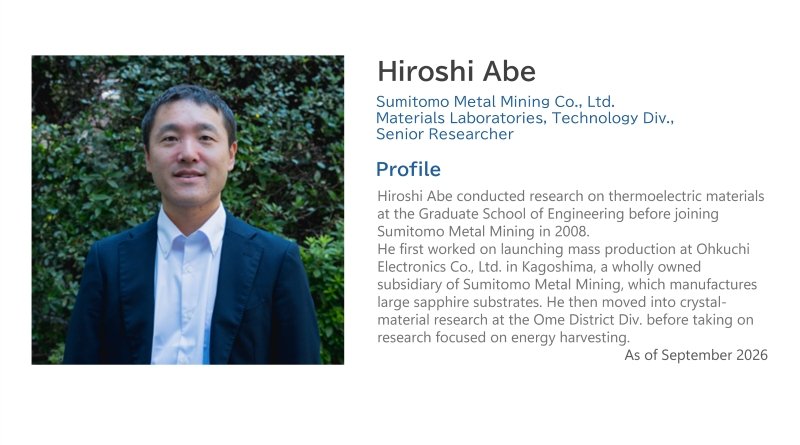
High-temperature heat is generated every day in factory operations, yet most of it goes unused. Hiroshi Abe, a senior researcher in the Materials Laboratories at Sumitomo Metal Mining, is working to establish a technology that converts such “wasted heat” into electricity through the development of magnesium-tin single-crystal materials.
Energy harvesting is a technology that converts tiny amounts of energy, such as light, heat, vibration, and radio waves into electricity. In this interview, we asked Abe about his efforts to connect this technology to solving social challenges and his thoughts on its practical implementation.
Abe: I have been interested in electricity and programming since I was a school student. That led me to study engineering at university, where I encountered thermoelectric materials in a lab. I found the idea of generating electricity from heat fascinating. I was also strongly drawn to crystal materials, because their performance varies significantly depending on their structure.
Wondering things like, “How are these atoms arranged?” or “How does the crystal’s structure affect material properties?” was genuinely enjoyable. That experience made me want to stay involved in research for the rest of my life.
Abe: There are many different fields within scientific research, but I was especially interested in working with crystal materials. While searching for a job where I could realize that goal, I learned about Sumitomo Metal Mining.
There are not many companies that develop crystal materials and supply them into society as products. Among them, Sumitomo Metal Mining stands out for its strength in single-crystal materials, and I felt it was a place where I could make use of both my interests and my laboratory experience.
In fact, after gaining experience in manufacturing and quality control at a subsidiary factory, I was able to move into crystal-material research. Later, when the company launched a new research theme centered on energy harvesting, I revisited the thermoelectric materials field which I had researched during my time as a student.
Abe: A thermoelectric material is one that converts heat into electricity.
For example, in factories, most of the high-temperature heat generated during manufacturing is simply released without being used. Converting heat into electricity through thermoelectric materials would lead to more efficient energy use as well as contributing to carbon neutrality.
We are now working on making thermoelectric materials like single crystals. Although most conventional thermoelectric materials are polycrystalline, we believe that by leveraging the single crystal production technology our company has refined over time, we can develop thermoelectric materials with performance that has yet to be achieved.
Currently, we are developing a magnesium tin compound single crystal that generates electricity in response to temperature differences. We are aiming for low-cost production using a method known as the VB (Vertical Bridgman) Method. This material is expected to perform well even in high-temperature and high-load environments. If it can be applied to waste heat generated from factories and other high-temperature sources, it could turn much of that “wasted heat” into “valuable heat.”
Abe: We have already been able to grow crystals up to 1 inch in size while maintaining good performance, thanks to the expertise we have accumulated in this field. However, a thermoelectric material cannot create value on its own. Its true value is realized only when it is turned into a module and integrated into actual equipment that customers can easily use. To make that happen, we are gradually moving into the stage of looking for co-creation partners.
We want to actively collaborate with device manufacturers, thermal management companies, and companies involved in factory equipment and energy-saving solutions.
Abe: I used to think rather simply that if a material was excellent, society would naturally want it. I was confident that this thermoelectric material was world-leading in terms of size and performance. But when I visited a customer and explained the material’s appeal, I did not get the reaction I had expected. The reason was that I had been focusing only on the material’s quality and performance and had not considered enough what module or system the customer actually needed.
That experience made me deeply realize the importance of understanding what is truly needed, and it became a turning point that changed my approach to research.
I came to think that a researcher’s role is not limited to making good materials, and that society cannot be changed by my own efforts or my company’s efforts alone.
We need to work together with many companies and stakeholders: companies that make modules, companies that develop power-generation systems, and the people who actually use those systems in the field.
To achieve this, it is important to go out and talk with other people and shape technology together, instead of trying to solve everything from inside the laboratory alone.
Recently, I have also been actively attending exhibitions and academic conferences, while working to accelerate and expand the adoption of our thermoelectric technology in society.
We are also moving the research forward in collaboration with colleagues inside the company who have different areas of expertise. For example, when someone says, “Ask that person about polishing,” or “That person is a specialist in crystal growth,” new ideas can emerge by bringing together each person’s specialized knowledge. When colleagues come together to share knowledge and technologies, stalled research can move forward.
I feel that new forms of collaboration are beginning to emerge precisely because our company has spent many years refining a wide range of technologies.
Abe: Above all, I want to bring thermoelectric materials based on magnesium-tin compound single crystals into the world.
Thermoelectric materials have many possible applications. To realize this potential, I want to continue going out into the world, seeking new opportunities and building more partnerships. We have long-cultivated expertise in single-crystal material development. If we combine that technology with the strengths of various companies and research institutions, I am sure we can create new worth.
We dream of the day when our thermoelectric materials take flight as a technology that benefits many people, and we will continue to take on new challenges by working together with many partners.
For more details on thermoelectric power generation introduced in this discussion, please see below:
Putting Waste Heat to Work: The New Wave of Thermoelectric Power Generation
「X-MINING is a new co-creation initiative that aims to create future-focused innovations by “crossing” your ideas with our materials to “mine” new value that impacts society.
Sumitomo Metal Mining is one of Japan’s leading resource and smelting companies. We have unique technology and materials expertise. It is no longer enough to keep these resources to ourselves. To make the most of them and achieve innovation, we must collaborate with partners. This is the vision of X-MINING.
On This Website, we introduce a wide range of functions, technologies, and solution examples of our materials. We aim to combine our products with your ideas to create new value that impacts society.
Ready to get started? Contact us to talk about your requirements.
Introducing Sumitomo Metal Mining’s material products,
which are the starting point for X-MINING innovation.