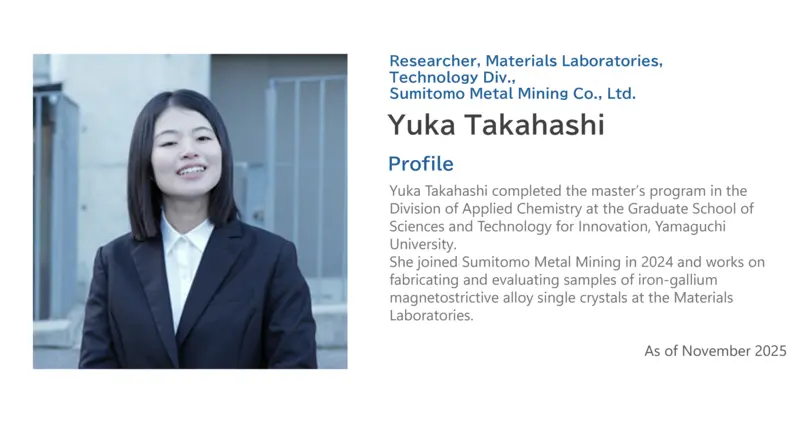
Fe-Ga Alloy Single Crystal 【R&D】


閉じる
閉じる
Search

Kansai University and Sumitomo Metal Mining are collaborating on research and development of self-powered sensing devices for monitoring the structural condition of bridges. In Part 2 of this issue of X-TALK, they discuss the potential for industry-academia collaboration based on their partnership, and Professor Koganezawa shares his vision for future research. Read Part 1
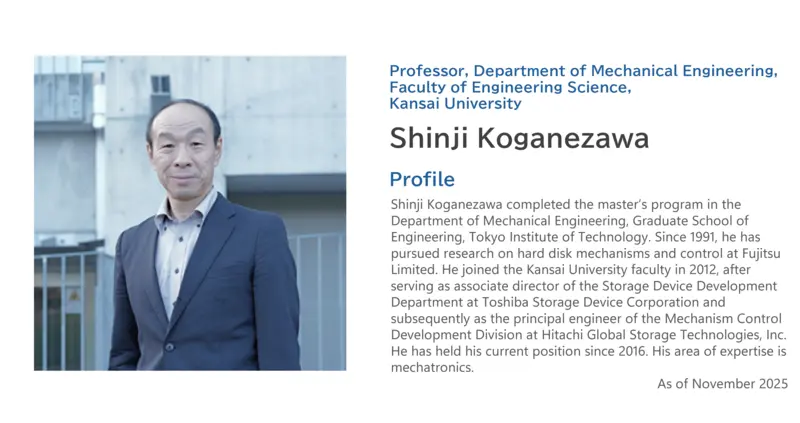
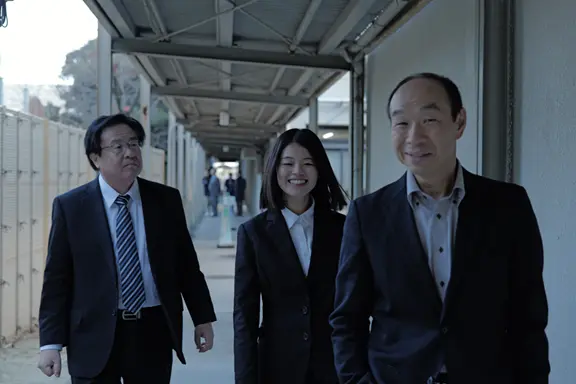
――Professor Koganezawa, you have extensive research experience in the private sector. What are your views on the benefits and significance of industry-academia collaboration?
Koganezawa: I think it’s quite common in human psychology for people to pay little attention to something acting alone, but can’t help noticing it when it’s part of a group. Industry-academia collaboration follows much the same pattern. For topics with little public interest, collaborating with various organizations—rather than staying within the university—makes it easier to get people’s attention. Once society is engaged, it’s much smoother to move toward real-world implementation. That’s the real appeal of industry-academia collaboration. Of course, some people become interested in a paper written by a professor and approach the university, so I certainly don’t intend to dismiss the value of research pursued solely within a university. But the theme I’m working on now is one that calls for early real-world deployment, so it needs to gain recognition more quickly and more widely. In that sense, I believe industry-academia collaboration is an effective approach.
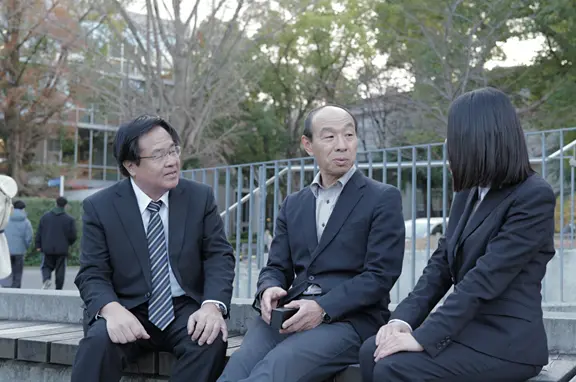
Takahashi: Speaking from the industry side, I’d like to point out that it’s difficult to judge a material’s value based only on in-house lab work. But if the materials we develop are used in research, like that being carried out by Professor Koganezawa, and the results are shared with us, that motivates us to further improve the material properties. It also gives us broader insights than we would otherwise gain from research done solely in our own laboratories. For me, it feels like I end up learning twice as much.
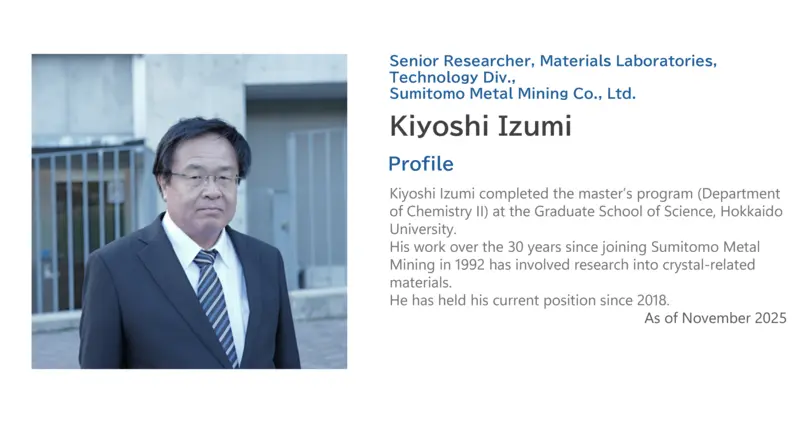
Izumi: When I joined the company, there was almost no industry-academia collaboration, much less joint research between companies. Sharing research results with other companies was out of the question. It was an era when people immersed themselves in research behind closed doors. But the chances of making anything happen that way were low. Rather, I saw that kind of situation again and again—development didn’t move faster, and while we were dragging our feet, other companies would succeed first. Times have certainly changed.
Koganezawa: My lab often gets offers from private companies to engage in joint research. I’ve worked in the private sector, so I appreciate how industry-academia collaboration has a different kind of value compared to research done solely within a university.
Izumi: Now we’re living in an era of co-creation—we learn what should be learned from others, and we teach what should be taught. I believe forming mutually beneficial relationships and gaining knowledge from outside the company will become increasingly necessary in the future.
――With the service-life issue of transportation infrastructure compounded by labor shortages, the demand for Professor Koganezawa’s research is likely to grow further. How do you hope self-powered sensing devices will spread going forward?
Koganezawa: The Ministry of Land, Infrastructure, Transport and Tourism (MLIT) is also participating in our project. I think it’s hugely significant that the government recognizes the service-life problem related to transportation infrastructure as a social issue. Since we Japanese tend to be slow to get started, I think the process will go like this: someone develops a solution, more and more people come to recognize its effectiveness, the solution is deployed in the real world, and only then do others say, “Maybe we should try it too.” Once we can provide something that truly matches a need, it will spread quickly, like falling dominoes.
Takahashi: What’s your goal in terms of a timeline for achieving real-world deployment?
Koganezawa: By 2027, while our project with the MLIT is still underway, we plan to have a certain amount of data in the cloud and perform repeated analyses using that data. We’ll be installing sensing devices on bridges across Japan, including in Maebashi City, Hiroshima City, and the Wakayama Prefecture section of the Hanwa Expressway. We expect the number of cooperating sites to grow. We plan to steadily accumulate data in the cloud using data obtained from these locations, demonstrate the effectiveness of the sensing devices, and set off a domino effect. I hope to see the successful commercialization of our technology by around 2028–2029.
――I imagine that establishing a supply chain will be a critical part of the commercialization process. Are there any specific actions you’re taking to build such relationships?
Koganezawa: Little by little, we’re making progress in building relationships. I’m working with several companies, primarily those involved in module design and development, and communicating with them about various matters to move forward with real-world deployment.
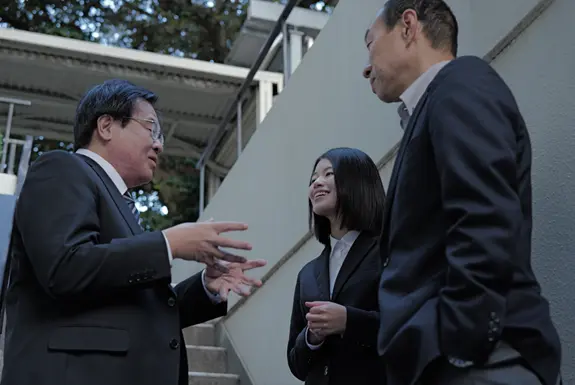
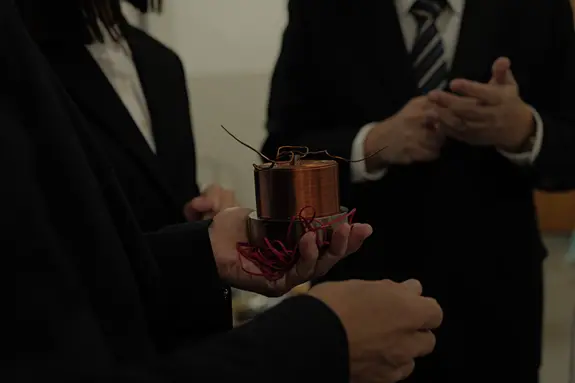
Izumi: We don’t develop systems, and the most we can directly contribute is the supply of magnetostrictive materials. But I don’t believe that should be the extent of our involvement. We’re constantly looking into where demand exists for devices that use our materials. While Professor Koganezawa focuses on device research and data analysis, we’d like to build the supply chain on the materials side, so that the respective supply chains can intersect.
Takahashi: As Professor Koganezawa has said, once this technology is deployed in the real world, everyone will follow suit. I think that’s exactly right. When I speak with customers at trade shows and other events, they often ask, “Has this already been put to practical use?” We also want to do whatever we can, from the materials side, to help accelerate real-world deployment. The technology itself is highly appealing because the sensors can generate their own power. We’re hoping to offer whatever support we can by communicating the effectiveness and appeal of Professor Koganezawa’s research.
Koganezawa: Thank you. My goal is to eventually have the sensors integrated directly into bridge bearings. To get to that point, I’ll have to collaborate with bearing manufacturers, as well as with companies that specialize in civil engineering technologies of that kind as I build the supply chain. My ultimate goal is to make that a reality and have self-powered sensing devices recognized as part of the infrastructure itself.
Learn more about the technologies featured in this dialogue:
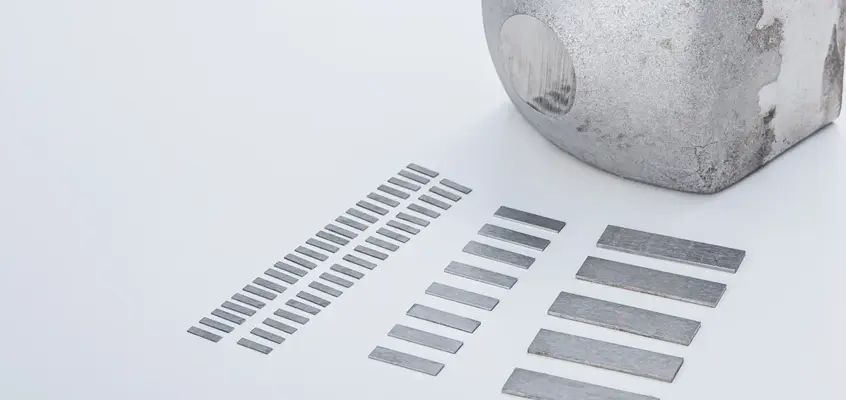
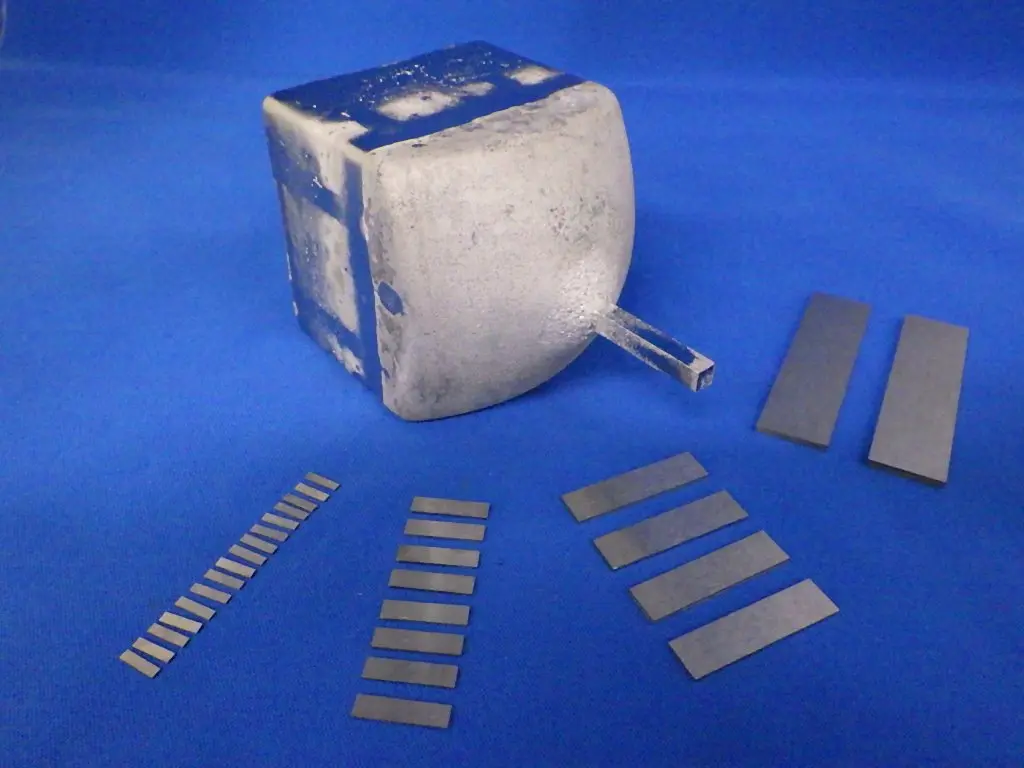
Sumitomo Metal Mining’s single-crystal Fe–Ga magnetostrictive alloy
「X-MINING is a new co-creation initiative that aims to create future-focused innovations by “crossing” your ideas with our materials to “mine” new value that impacts society.
Sumitomo Metal Mining is one of Japan’s leading resource and smelting companies. We have unique technology and materials expertise. It is no longer enough to keep these resources to ourselves. To make the most of them and achieve innovation, we must collaborate with partners. This is the vision of X-MINING.
On This Website, we introduce a wide range of functions, technologies, and solution examples of our materials. We aim to combine our products with your ideas to create new value that impacts society.

X-TALK
 Iron-Gallium Magnetostrictive Alloy Single Crystals
The Potential of Self-Powered Sensing Devices and Industrial Applications Enabled by Iron-Gallium Magnetostrictive Alloy Single Crystals
Iron-Gallium Magnetostrictive Alloy Single Crystals
The Potential of Self-Powered Sensing Devices and Industrial Applications Enabled by Iron-Gallium Magnetostrictive Alloy Single Crystals

X-TALK
Iron-Gallium Magnetostrictive Alloy Single Crystals
The Potential of Vibration Power Generation Devices Enabled by Iron-Gallium Magnetostrictive Alloy Single Crystals
Article

Article
Ready to get started? Contact us to talk about your requirements.
Introducing Sumitomo Metal Mining’s material products,
which are the starting point for X-MINING innovation.