Near-Infrared-Absorbing Materials

閉じる
閉じる
Search
As summers get hotter every year, increased attention is being paid to heat-control measures for buildings.
When thinking about heat control, one important factor is the Near-Infrared (NIR) light in sunlight, which is a major cause of heat buildup.
Sumitomo Metal Mining’s near-infrared-absorbing material, SOLAMENT™, is designed to absorb near-infrared light while still allowing visible light to pass through. For that reason, it is used in heat-control applications on various types of windows and transparent roofing materials.
In this article we will explain:
• Why near-infrared light matters for heat control
• The features of SOLAMENT™ as a material
• Test results from demonstration experiments
• Examples of real-world adoption
• How the material can be applied
Buildings with large windows or extensive glass surfaces create a bright, open-air feeling. At the same time, they also tend to absorb more sunlight during summer, which makes indoor temperatures rise more easily.
For large buildings such as office towers, public facilities, and commercial buildings, this directly increases the load on air conditioning systems.
That is why heat control for windows has become an essential part of heat reduction strategies.
Methods such as blinds and curtains can reduce sunlight, however depending on the building, they may also interfere with daylighting or the overall appearance of the space. As a result, demand is growing for windows that can help control heat by themselves.
Sunlight contains ultraviolet light, visible light, and near-infrared light. Among these, visible light is closely related to brightness and how a space looks, while near-infrared light has a greater impact on perceived heat and on the actual temperature of building materials.
If all sunlight is blocked, the space becomes dark. The key is to let in the necessary sunlight for luminance, while reducing the near-infrared light that causes heat buildup. That balance is what helps create a more comfortable indoor environment.
SOLAMENT™, Sumitomo Metal Mining’s near-infrared-absorbing material, is designed to target the near-infrared range of sunlight, which is one of the main sources of heat. It presents a solution by helping preserve the necessary visible light for brightness, while absorbing the near-infrared light that contributes to heat buildup. Since its release, it has been used in building windows and roofing.
We conducted experiments to compare the temperature rise of two windows. One was coated with SOLAMENT™, specifically Smart Coat, produced by Hasegawa Environmental Development Co., Ltd. and another one without SOLAMENT™ coating, under the same environmental conditions.
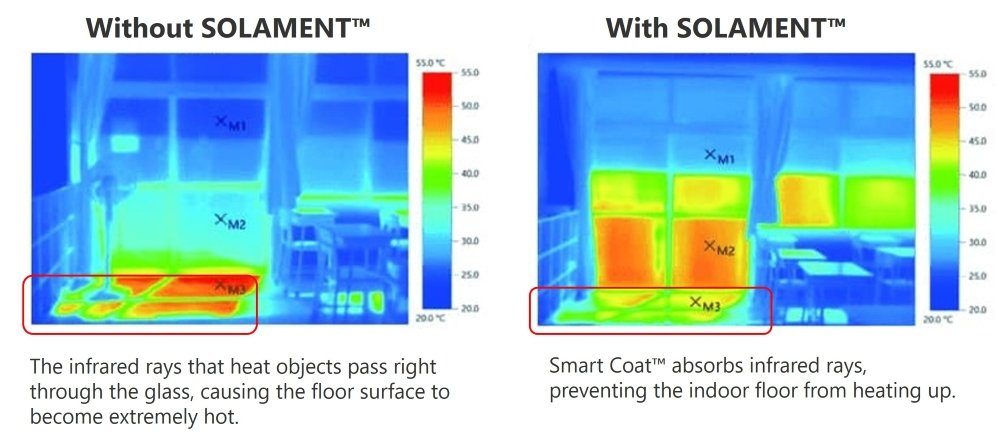
Figure 1 shows a thermographic comparison of temperatures of both surfaces, with and without SOLAMENT™. In thermographic images, hotter areas appear red, while cooler areas appear blue.
On the left, the uncoated window glass allows near-infrared light to pass through and reach the floor, which raises the floor temperature. In the lower part of the image, floor temperatures above 50°C can be seen.
On the right, the window material coated with SOLAMENT™ absorbs the near-infrared light at the window, keeping the floor temperature at around 35–40°C.
SOLAMENT™ has been adopted and considered for a wide range of sites, including public facilities, commercial facilities, and office buildings.
Examples include National research organizations, universities, government-related institutions, commercial facilities, and manufacturing plants.
| CATEGORY | EXAMPLE SITES |
| GOVERNMENT INSTITUTIONS | The Institute of Statistical Mathematics National Institute for Educational Policy Research Tokyo Gakugei University Shizuoka Tax Office Agriculture, Forestry and Fisheries Research Council |
| COMMERCIAL FACILITIES / STORES | Multiple Aeon Mall locations Dozens of major convenience store locations |
| FACTORIES | Mitsubishi Electric Corporation Itami Works Mitsui Chemicals, Inc., Mobara Branch Factory Megmilk Snow Brand Ebina Plant |
It is also being considered for buildings that want to reduce heat while still maintaining daylight and visibility, as well as for sites that need heat-control performance tailored to specific construction conditions.
When it comes to applying heat-control materials to windows, the two most common methods are film and coating.
The best choice depends on the desired application and construction conditions.
Film can be installed with relative ease on existing windows, which makes it a convenient option for renovation projects.
It also tends to preserve enough transparency well, making it an excellent fit when the goal is to upgrade existing windows without changing their appearance too much.
Like film, coating can also be applied to existing windows after installation.
It is easier to apply over large areas or complex shapes. Also, depending on the construction conditions, it may also be applied around windows as well as on other exterior surfaces of large buildings and any areas exposed to direct sunlight.
One of SOLAMENT™’s strengths is the ability to be used in various forms such as film and coating, while delivering strong thermal control performance.
If you are a corporate client and would like to learn more about application methods, our marketing team can help.
If you are a building materials manufacturer, contractor or representative, please feel free to contact us.
Contact us about application methods
When considering heat control, a key point is handling the near-infrared light that causes heat accumulation.
As a material that absorbs near-infrared light to reduce heat, while preserving the daylight needed for brightness, SOLAMENT™ offers a viable solution. Being available in two main application methods, film and coating which are suited to different uses, it can be considered according to the intended use and construction conditions.
If you are interested, please feel free to contact us.
For more information, please refer to the product details and downloadable materials below:
[Product details] near-infrared-absorbing materials SOLAMENT™
[Download datasheets] near-infrared-absorbing materials
Taking advantage of this feature, this technology can be applied not only to windows but also as thermal control for buildings, agricultural materials, and even umbrellas, depending on the intended use/making it a versatile material for a variety of uses.
If you are interested in other application examples, please see:
[Case Study] Preventing Excessive Temperatures in Greenhouses
[Case Study] Windows That Block Heat While Allowing Light
X-Mining combines profound expertise in materials science with industry insights to innovate and solve challenges. If you see potential for collaboration, please contact us with any questions.
Introducing Sumitomo Metal Mining’s material products,
which are the starting point for X-MINING innovation.