Fe-Ga Alloy Single Crystal 【R&D】


閉じる
閉じる
Search
Fe-Ga magnetostrictive alloys combine excellent magnetostrictive performance with robust mechanical properties. These alloys have drawn attention for their use in vibration-power generation, which is a form of energy harvesting. They have applications not only for vibration-power generators, but also for sensors, actuators, and other products. This column presents an overview of single crystals of Fe-Ga magnetostrictive alloys and examples of their applications.
Magnetic materials* such as iron and nickel contain microscopic regions known as magnetic domains, in which magnetic moments are aligned in a common direction. When a magnetic field is applied to such a material, the magnetic moments align with the magnetic field, resulting in a slight deformation of the material. This phenomenon is called the magnetostrictive effect.
Conversely, when an external mechanical force is applied and the magnetic material is slightly deformed, the direction of the magnetic moments inside the material changes according to the direction of the applied force, changing how easily magnetic flux passes through the material (i.e., the magnetic permeability). This phenomenon is called the inverse magnetostrictive effect.
Materials that exhibit a large magnetostrictive effect are referred to as magnetostrictive materials, and because of their properties, they are widely utilized in applications such as magnetostrictive vibration sensors and actuators.
(*Magnetic material: a material that becomes magnetized and exhibits magnetic properties when subjected to an external magnetic field.)
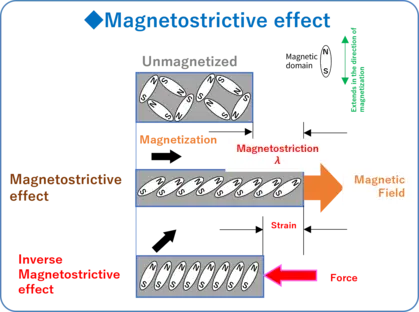
Magnetostrictive effect: When magnetized, shape changes
Inverse magnetostrictive effect: When force is applied, magnetic flux changes
1) Generating electricity from vibration (vibration energy harvesting, vibration sensing)
When vibration is applied to a magnetostrictive material around which a coil is wound, a change occurs in the density of magnetic flux passing through the magnetostrictive material, generating a voltage in the coil via electromagnetic induction. The generated voltage can be used as electric power (vibration energy harvesting). The generated voltage can also be used as a signal to indicate vibration information (vibration sensing).
2) Generating vibration from electricity (vibration actuation)
Electric power is applied to the coil wound around a magnetostrictive material. The current in the coil produces a magnetic field, and by changing this magnetic field (for example, by using an AC current), the magnetostrictive material repeatedly expands and contracts. This expansion and contraction generate vibration.
3) Converting external changes into electrical signals (e.g., magnetic, stress, strain sensing)
A coil is wound around a magnetostrictive material. A slight change in the external magnetic field, stress, or strain applied to this material changes the magnetic flux density passing through it, generating a voltage in the coil. This voltage serves as a signal to detect those changes.
Fe-Ga magnetostrictive alloy, an iron-based magnetostrictive material, demonstrates both a significant magnetostrictive effect and superior mechanical properties, and has drawn attention in recent years as a core material for magnetostrictive vibration energy harvesting. In addition to vibration energy harvesting, applications as a core material for sensors and actuators are also being studied. The main characteristics of Fe-Ga magnetostrictive alloy are shown below:
Features of Fe-Ga alloy
✓ Magnetostriction: Approximately 300 ppm (about 10 times that of iron)
✓ Young’s modulus: 70 GPa (about the same as aluminum)
✓ Tensile strength: 400 MPa (about the same as iron)
⇒ Attracting attention as a material for magnetostrictive vibration energy harvesting
For many years, Sumitomo Metal Mining (SMM) has produced crystal materials for a wide range of applications and has acquired expertise in single-crystal growth and crystal-processing technologies. Using this expertise, SMM developed Fe-Ga magnetostrictive single crystals. These single crystals are suitable for magnetostrictive vibration-energy harvesting for the Internet of Things (IoT). Researchers are also studying how sensors or actuators can leverage the properties of these crystals.
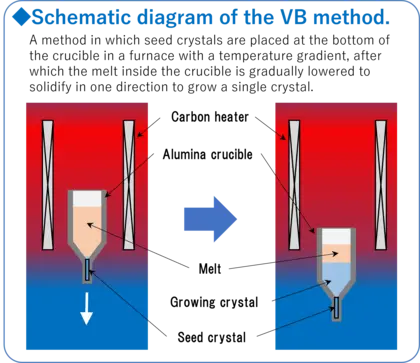
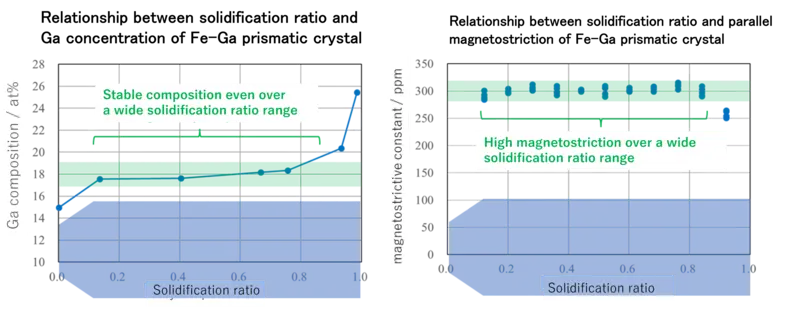
Development of Fe-Ga magnetostrictive alloy single crystal growth technology based on the Vertical Bridgman (VB) method is currently underway at Sumitomo Metal Mining (Figure 2). The magnetostrictive performance of Fe-Ga magnetostrictive alloys is significantly affected by variations in the Ga concentration within the alloy, and the VB method makes it possible to minimize variations in the Ga concentration within grown single crystals (Figure 3: left). Additionally, applying special post-processing aligns the directions of the magnetic domains within the material, making it possible to produce magnetostrictive materials characterized by high magnetostriction and small variation in magnetostrictive properties (Figure 3: right).
At present, growth of single crystals in the form of rectangular prisms up to approximately 66 mm × 100 mmL has been achieved. These single crystals can be cut to produce magnetostrictive materials of various sizes and shapes.
Shown below are examples of applications based on Fe-Ga magnetostrictive alloy single crystals for vibration energy harvesting, vibration sensing, and vibration actuation.
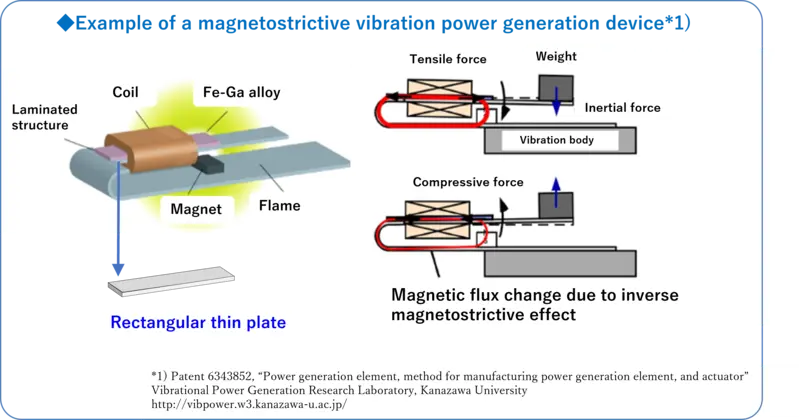
Figure 4 shows the structure of the device. A plate-shaped Fe-Ga magnetostrictive alloy is bonded to a U-shaped steel frame; copper wire is wound around that portion; and a permanent magnet is placed under the end of the Fe-Ga magnetostrictive alloy plate. This configuration creates a closed magnetic circuit (indicated by the red line in Figure 4) in the vibration power generation device. When a weight is attached to the tip of the frame and the vibration power generation device is fixed to a vibrating body, the weight vibrates up and down due to inertial forces acting on the weight. This vibration deforms the frame and applies, in alternation, tensile and compressive forces to the Fe-Ga magnetostrictive alloy plate bonded to the frame. Due to the inverse magnetostrictive effect, this changes the ease with which magnetic flux passes through the Fe-Ga alloy plate (i.e., the magnetic permeability), causing magnetic changes within the coil, which in turn generates a voltage. This voltage can be extracted as a direct current through an electric circuit and used as a self-sustaining power source in the field of the IoT (Internet of Things) and other fields.
Reference: Magnetostrictive Bridge Sensor Device, Laboratory of Machine Design and Tribology, Kansai University
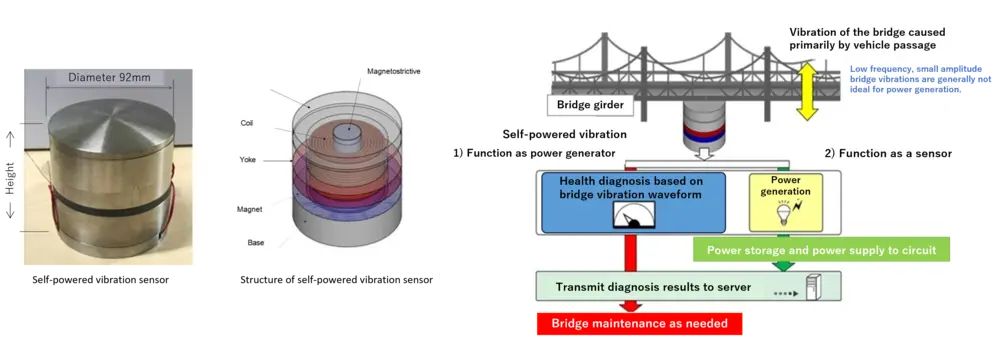
Figure 5 shows the structure of the device. A coil is wound around a cylindrical Fe-Ga magnetostrictive alloy. Magnets are arranged around the coil to apply an external magnetic field. A yoke, which is a circuit that magnetically couples the magnets, is formed with SS400 (rolled steel plate). This design results in a vibration-sensor device that has a structure that is covered with SS400.
The device is deployed between the main beam and the bridge pier.
When a vehicle passes over the bridge, the beam moves up and down, applying vertical compressive stress to the cylindrical magnetostrictive material.
The applied stress alters the magnetic permeability of the material, causing changes in the magnetic-flux density within the coil, which generates a voltage. This voltage can be rectified, stored, and used as direct-current power.
The magnitude of the generated voltage correlates with the vibration of the bridge. Therefore, the system can analyze this voltage as bridge-vibration data to assess the bridge's condition. The system stores the electrical power that bridge vibrations generate in a secondary battery. At fixed intervals, it acquires and analyzes bridge-vibration data to diagnose the bridge's condition. It can also transmit these results to a server via wireless communication. This automated system, which combines vibration sensing with power generation, significantly reduces manual inspections and diagnoses.
In electronic component mounting machines, higher operating speeds and an increasing number of nozzles have led to heavier and more complex head assemblies. These changes make residual vibrations more difficult to suppress using stage position control alone, limiting further improvements in head movement speed and positioning time.
To overcome this challenge, Panasonic Connect has developed an active vibration control mechanism that can both support heavy head structures and actively suppress residual vibrations. The system uses Fe–Ga magnetostrictive alloy single crystals to generate vibrations in the opposite phase, effectively damping unwanted motion. The performance of this mechanism was verified through experimental evaluation.
Figure 6 shows an overview of the active vibration control experimental apparatus. The setup consists of an inverted pendulum that represents the head assembly, mounted on a stage motion mechanism that moves in a specified direction. A pair of magnetostrictive fine-motion actuators is installed at the base of the inverted pendulum. These actuators expand and contract vertically in response to an applied electric current, enabling precise vibration control.
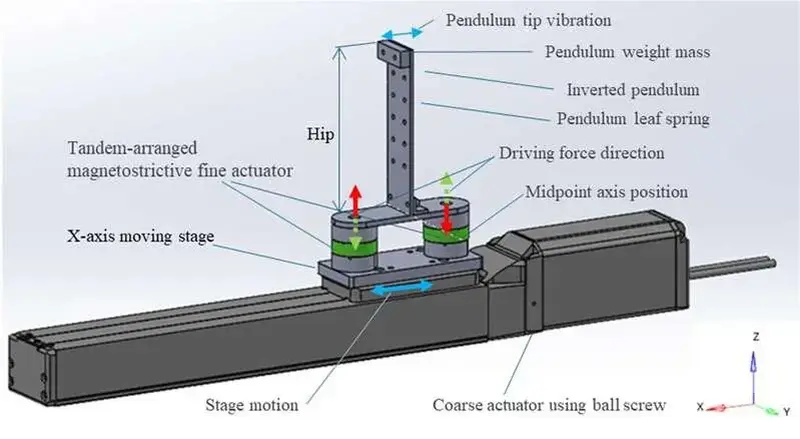
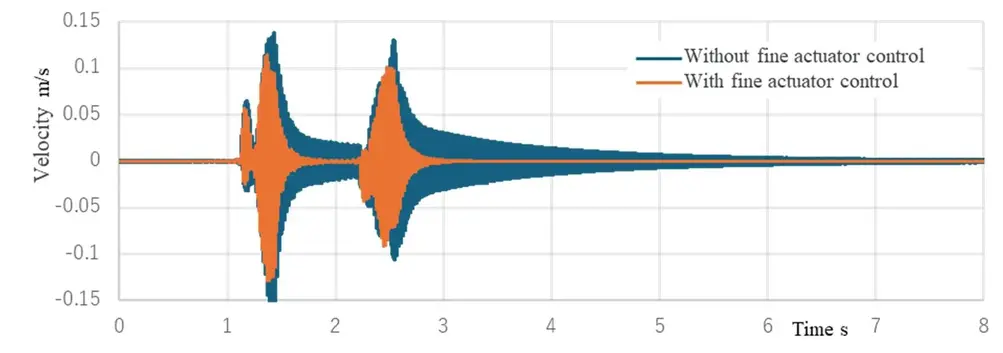
During stage motion, the vibration velocity at the tip of the inverted pendulum was measured, and feedback control was applied to drive the magnetostrictive actuators to generate out-of-phase vibrations. As shown in Figure 7, activating the actuators dramatically reduced residual vibrations, achieving vibration damping in a very short time compared with conventional operation. The vibration decay time was reduced by more than 90%, demonstrating that active vibration control and robust support of heavy structures can be achieved simultaneously.
This technology is expected to contribute to higher-speed, higher-precision industrial equipment. Potential applications include electronic component mounting machine heads and other systems that require active vibration control while supporting heavy loads.
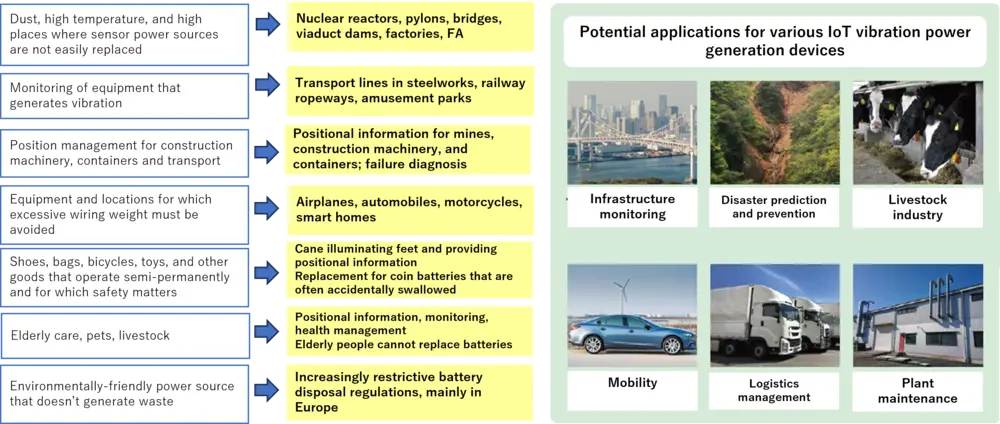
Magnetostrictive alloy single crystals have a wide range of potential functions, including vibration energy harvesting (converting vibration into electric power), sensing (converting micro-vibration and other small changes such as those in a magnetic field, stress, strain into voltage signals), and actuation (outputting vibration from electric power). They hold the promise of broad applications, new devices, and the creation of new value.
Even when using vibration energy harvesting alone, combining this technology with the Internet of Things (IoT) presents unbounded potential. This combination can operate sensors in remote locations. It can also collect real-time information about the weather and the environment, the movement and position of people and objects, and the integrity of structures and equipment.
Decreasing or eliminating the need to replace batteries reduces both waste and the burden of maintenance. Vibration energy harvesting will likely create innovative value across industry, infrastructure, transportation, logistics, social welfare, the environment, entertainment, and daily life in general.
Sumitomo Metal Mining (SMM) produces high-quality Fe-Ga magnetostrictive alloy single crystals through proprietary single crystal growth and processing technologies. Working with device manufacturers, universities, and various other parties through open innovation, SMM plans to develop devices and applications that leverage high-quality single crystal magnetostrictive materials to help create new value in wide-ranging fields.
X-Mining combines profound expertise in materials science with industry insights to innovate and solve challenges. If you see potential for collaboration, please contact us with any questions.
Introducing Sumitomo Metal Mining’s material products,
which are the starting point for X-MINING innovation.