Near-Infrared-Absorbing Materials

閉じる
閉じる
Search
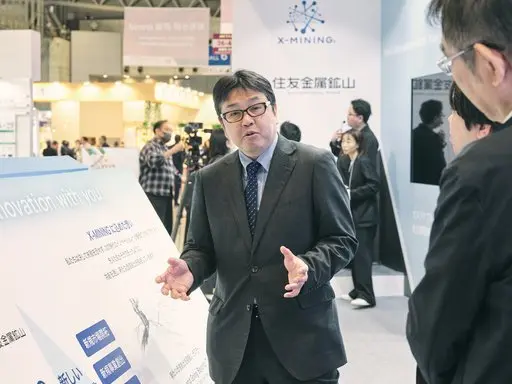
The 5th Sustainable Material Expo (SUSMA) was held at Makuhari Messe over a three-day period starting November 12. Sumitomo Metal Mining gave an overview of its efforts to resolve social issues through co-creation under the theme of “Next Innovation With You,” with a focus on X-MINING, its information portal for functional materials launched in 2020. In this article, we will report on the SUSMA event through interviews with the employees in charge of this exhibition.
We will start by discussing the “Next Innovation With You” theme adopted by Sumitomo Metal Mining in preparation for SUSMA.
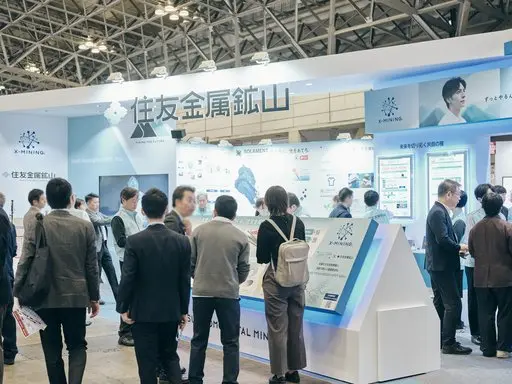
As a manufacturer of nonferrous metals, Sumitomo Metal Mining has continued to adapt to changing environments and society’s needs for more than 430 years. Today, the company is focusing its efforts on initiatives aimed at realizing a circular economy and a carbon-neutral society by developing high-efficiency, energy-conserving functional materials and by adapting to a hydrogen-based society.
The key to sustaining this change lies in co-creation with partners with different specialized fields and expertise. Atsushi Tofuku, who oversees the X-MINING project aimed at creating new technologies and solutions through co-creation, explains the background to the launch of the project.
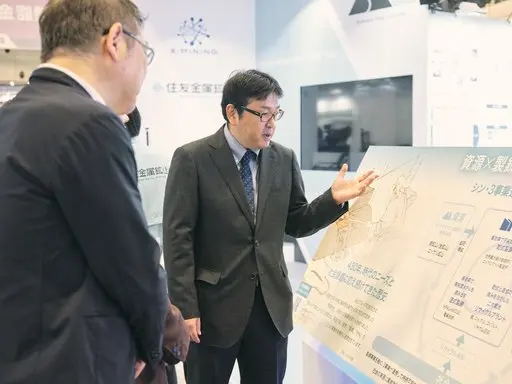
Tofuku: Our modern society is no longer in an era where a company can take the “the more products we manufacture, the more we sell” approach. Globalization, the growing complexity of social issues, and diversifying needs have rendered the future of the markets unpredictable. That’s made it hard for a single company and traditional business models to respond effectively to changes. In particular, the materials we handle are becoming commoditized more quickly. We face the challenge of differentiating our products based on factors other than their price. For all these reasons, we believe we need to become pioneers in new businesses and markets through chemical reactions based on co-creation with partners from different industries, who have ideas and perspectives that differ from our own.
In 2020, Sumitomo Metal Mining launched a dedicated website named X-MINING (this site) to introduce the diverse functions of its materials, technologies, and case studies on past solutions to attract co-creation partners. The site currently gets more than 100,000 views per year and serves as a hub for sowing seeds for numerous innovations. Co-creation projects with various industries have already emerged from this platform, and these projects are currently on the road to practical applications and real-world deployment.
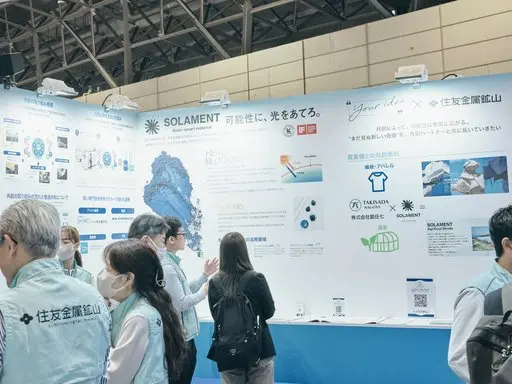
For example, as a solution to the problem of extreme heat waves in recent years, Sumitomo Metal Mining has produced a product that uses SOLAMENT™︎, a near-infrared absorbing material, and lowers temperatures inside greenhouses on farms to prevent crop failure and heatstroke of workers. The product has already entered practical use. Sumitomo Metal Mining is also working to create new value for this material in fields it has not participated in previously, such as apparel, the life sciences, and healthcare.
Tofuku: We came up with the idea for blending SOLAMENT™︎ into yarns to create warm, self-heating clothing. The response from the apparel industry to this idea was: “If clothes can be made from thinner fabrics, we can make more fashionable and more appealing clothing.” This would lead to a higher degree of freedom in clothing design and offer new added value to customers. As with this example, adopting a different approach to our materials can create new functions and value beyond specifications. It can significantly expand the potential of technologies Sumitomo Metal Mining has cultivated.
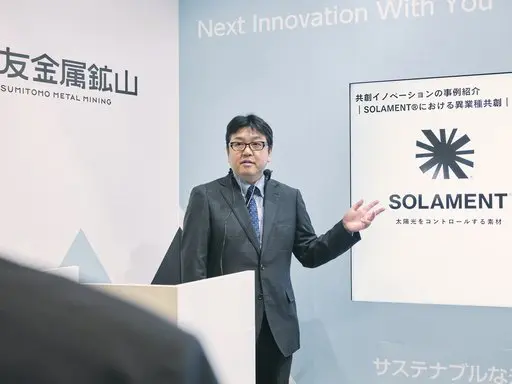
Currently, mid-sized companies and startups eager to take on new challenges are participating in co-creation projects with Sumitomo Metal Mining.
Tofuku: What often happens is that we get inquiries and requests from people interested in our functional materials and case studies, and new ideas emerge through repeated discussions and from the subsequent validation experiments done to test the theories developed through such discussions. That’s why I insist that our customers feel free to reach out to us with their questions, like, “Do you have a material with such and such function?”
Tofuku adds that he plans to work more closely with Sumitomo Metal Mining’s research and development departments to introduce new materials as they are being developed.
Tofuku: Our goal is to create new value that will have a significant impact on the world by taking a comprehensive view of the value chain and engaging in open innovation that involves the entire ecosystem. What interesting endeavors will emerge from the process of combining our functional materials with our partners’ businesses? We look forward to exploring these possibilities more deeply with people from a wide range of industries.
This section will highlight the three materials exhibited at SUSMA from among the seeds of co-creation currently in development.
First, we spoke with Kazuki Hanzawa from the Product Development Dept. about the metal organic decomposition (MOD) paste.
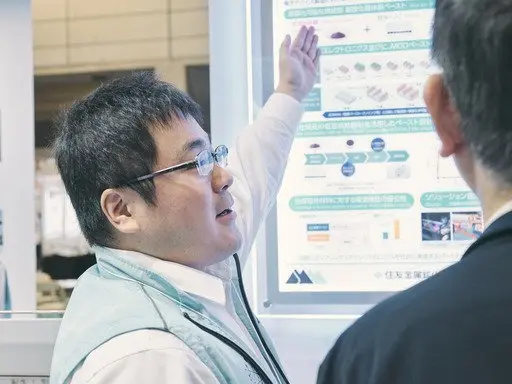
Hanzawa: MOD paste is a paste made by mixing low-temperature sinterable copper powder with a metal complex ink. The material is expected to promote the real-world deployment of printed electronics, whose electronic circuits are formed using printing technologies. Because it enables electronic circuits to be produced with fewer processes than conventional plating methods, it can reduce energy consumption as well as wastewater and waste volumes, reducing environmental impact.
Offering higher conductivity than conventional conductive inks, MOD paste can be processed at relatively low temperatures in a short time and is characterized by its excellent oxidation resistance. Since conductivity can be achieved at temperatures as low as about 200 °C, MOD paste can be printed directly onto resin substrates. This provides greater wiring flexibility and is ideal for high-mix low-volume production, significantly expanding the design possibilities for electronic devices.
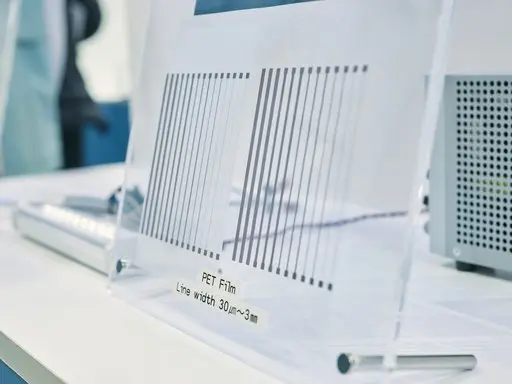
Hanzawa: While printed electronics has long been regarded as a promising technology for manufacturing electronic circuits, practical applications in the real world were thought to be limited. But now, MOD paste is attracting significant interest, particularly from device manufacturers and printed circuit board manufacturers, as a material with the potential to dramatically expand the possibilities for the real-world deployment of the technology. Since MOD paste makes it possible to form electronic circuits, including 3D wiring, on a variety of substrate materials, it may lead to the development of electronic devices with unprecedented designs.
Next, we talked to Hanzawa about the oxidation-resistant nano copper powder showcased in the adjacent booth. This copper powder can be sintered at low temperatures and is also used in the MOD paste.
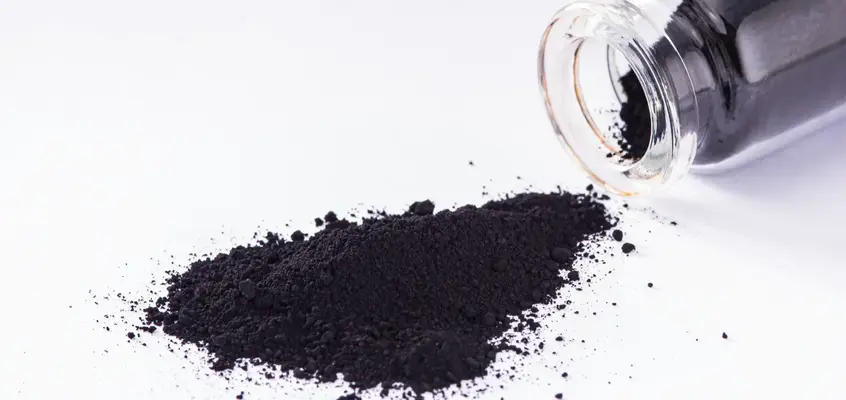
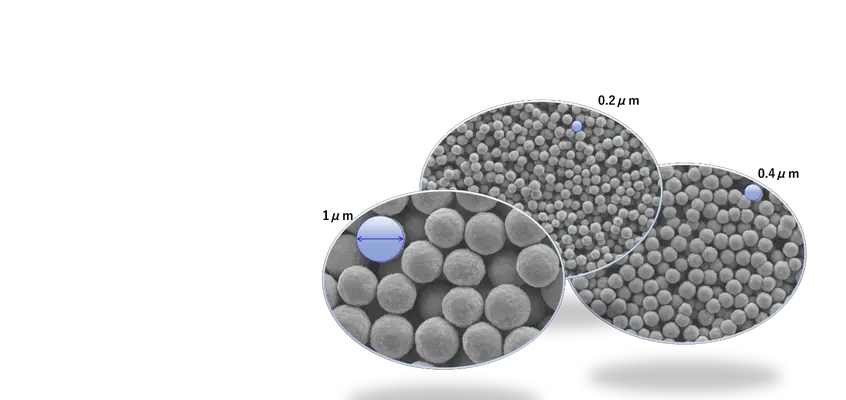
Hanzawa: In general, we can achieve a lower sintering temperature by reducing metal powder particle sizes. But when we turn copper powder into fine particles, it becomes susceptible to oxidation, which makes handling harder. We used our wet synthesis technology to create an organic coating for the surface, and we have developed a nano copper powder that exhibits high resistance to oxidation despite its fine particle size.
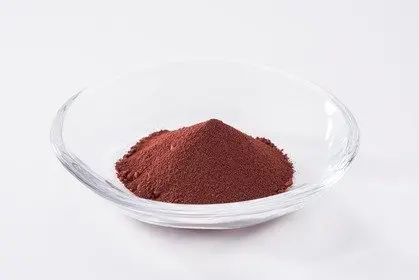
The ovens used in material synthesis typically operate at sintering temperatures of 500 °C or higher and consume a significant amount of electricity. Since the oxidation-resistant nano copper powder can be sintered at lower temperatures, it can contribute to reducing energy consumption. Also, because copper is cheaper than silver, manufacturers involved in developing silver conductive materials have high expectations that copper powder will replace silver powder to reduce costs. Interest in this material is also growing for its antibacterial, antiviral, and antifungal properties.
Hanzawa: Because catalytic effects can be achieved with only a small addition of oxidation-resistant nano copper powder, it can contribute to cost reduction and resource conservation. In recent years, some washing machine models have antibacterial and deodorizing features, which are achieved by releasing silver ions into the wash water. We’re investigating the idea of replacing the silver with the more affordable option of copper. We’ve received various other ideas, like immersing the copper powder in wastewater to prevent bacterial growth or using it as a catalyst for electrolytic reactions.
Finally, we spoke with Ryoto Egawa, a researcher at the Materials Laboratories in charge of the ENERGY HARVESTING (Vibration Power Generation Devices) booth.
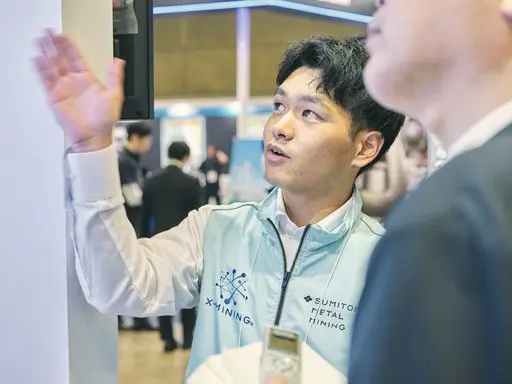
Energy harvesting is a technology that captures the minute amounts of energy present in the environment and converts it into electricity. This booth showcases a vibration power generation device developed by Kanazawa University’s Vibration Power Generation Research Laboratory.
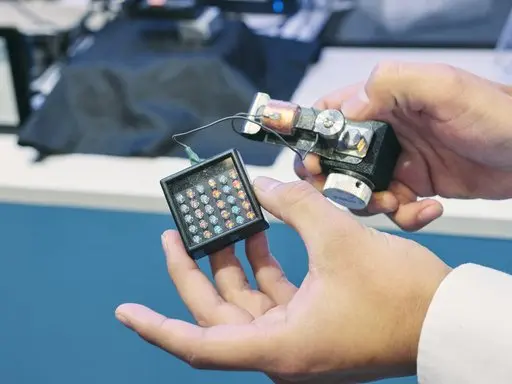
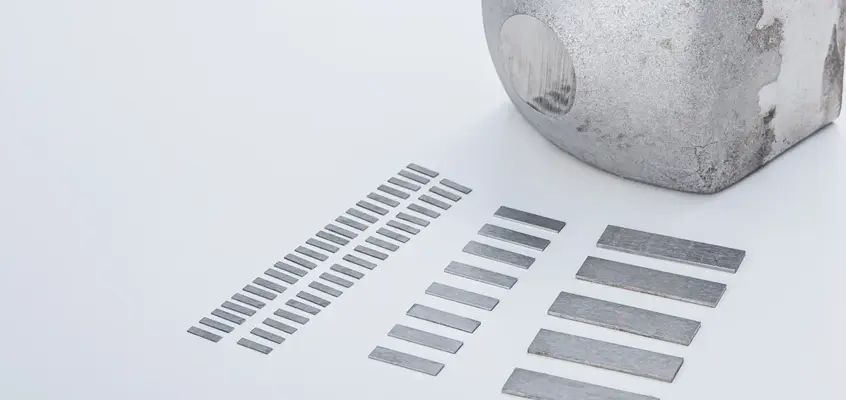
Egawa: This device draws on the properties of our iron-gallium magnetostrictive materials to generate electricity from magnetostriction-induced vibration. Magnetostriction refers to a property of metals whereby their shape changes when a magnetic field is applied and their magnetic permeability changes when an external force is applied. Leveraging this property makes it possible to create a self-sustaining IoT system that doesn’t require replacement of batteries or an external power source. One example of an application is a system to power devices for monitoring bridge deterioration by using electricity generated from bridge vibrations. Our iron-gallium magnetostrictive materials are high-quality, uniform single crystals achieved with our proprietary single-crystal growth and processing technologies. They can also be processed into various sizes and shapes.
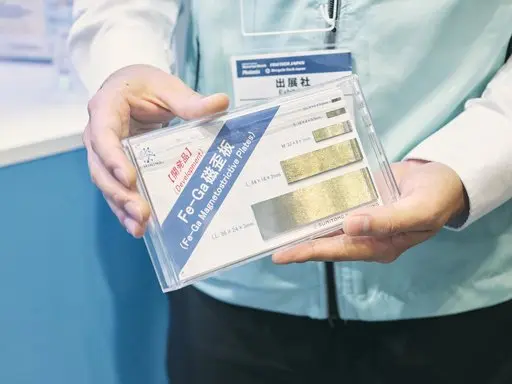
Egawa: Magnetostriction-induced vibration power generation is ideal for applications requiring the continuous operation of remote sensors to collect real-time data such as weather, environmental conditions, movements and locations of people and objects, and the integrity of structures and equipment. We anticipate this technology finding applications across a wide range of fields, including infrastructure monitoring, disaster prevention, livestock farming, pest control, mobility, logistics management, plant maintenance, and smart agriculture. At this exhibition, visitors from the railway and automobile sectors in particular showed keen interest. We’re also seeking partners for manufacturing devices focusing on specific fields.
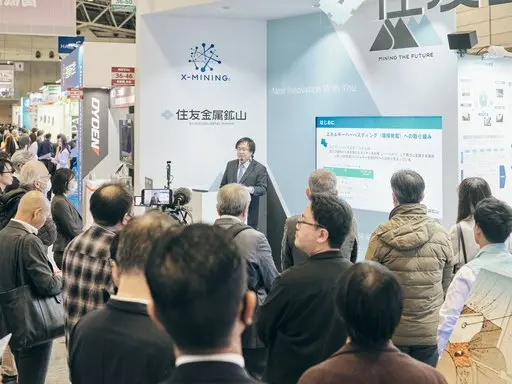
A total of eight functional materials were exhibited in addition to those introduced above. It was striking to see the intense attention from visitors, representing a wide range of industries, who listened to explanations from Sumitomo Metal Mining’s employees. The seminars hosted by Tofuku and others at the booth over the three-day period also attracted sizeable crowds.
Note: Click the link below to access the seminar archive videos (Japanese audio with English subtitles). Please register via the link below.
Access the materials and video download form here.
We plan to introduce more functional materials and examples of their applications on the X-MINING website. If you have any questions, issues, or ideas for collaboration, feel free to contact us via the website by clicking on the contact link.
Sumitomo Metal Mining is committed to achieving a more exciting future and a more sustainable society through co-creation with its partners.
X-Mining combines profound expertise in materials science with industry insights to innovate and solve challenges. If you see potential for collaboration, please contact us with any questions.
Introducing Sumitomo Metal Mining’s material products,
which are the starting point for X-MINING innovation.