Ultrafine Nickel Powders 【R&D】


閉じる
閉じる
Search
Research and development of various catalyst technologies are currently underway to realize a carbon-neutral society. Of these, a special focus is being placed on the following three technologies for their potential to serve as key solutions to achieving carbon neutrality. The first is the methanation process for artificially synthesizing methane (CH4), the main component of city gas, through the reaction between hydrogen (H2) and carbon dioxide (CO2). The second is hydrogen production, which involves the production of hydrogen (H2), an energy carrier, through the electrolysis of water (H2O). The third is fuel production, which involves the production of synthetic fuel (e-fuel) for use as transportation fuel and other applications using hydrogen (H2) and carbon dioxide (CO2) as the raw materials. The key to making these conversion reactions more efficient is the base metal catalyst, a material composed primarily of nickel (Ni) and copper (Cu). This article introduces the basics of base metal catalysts, particle design technology as a key aspect of catalyst design that can determine whether practical use will be successful, and the applications and future potential of base metal catalysts.
Catalysts are tools for making target chemical reactions progress more efficiently. Most chemical reactions require an activation energy to proceed; catalysts make it possible to make reactions happen with less energy. A catalyst allows reactions to proceed more readily even at the same temperature and pressure, allowing the target reaction product to be obtained more efficiently. Since the catalyst remains unchanged before and after the reaction, a catalyst designed to be optimal for the environment of the reaction will often be highly resistant to degradation, resulting in long catalyst service life and allowing the catalyst to repeat the chemical reaction.
For example, the methanation process commonly uses the Sabatier reaction. In this reaction, carbon dioxide emitted from plants and other facilities and derived from fossil fuels is recovered and reacted with hydrogen derived from renewable energy sources in the presence of a catalyst at high temperatures of approximately 500 °C. The synthesized methane is then returned to the plants and other facilities. The carbon dioxide produced in the combustion of the methane is also recovered.
So, in theory, the amount of carbon dioxide recovered for the methanation and the amount of carbon dioxide produced by the combustion of the synthesized methane should be equal. The basic principle of methanation is that the overall cycle does not increase the amount of newly generated carbon dioxide derived from fossil fuels, thereby enabling carbon neutrality.
Although the process of methanation itself has been known for a long time, highly efficient production technologies, including the improved low-temperature reactivity of the nickel catalysts used for the Sabatier reaction, are being established in recent years due to advances in nanoparticle synthesis and catalyst support technologies.
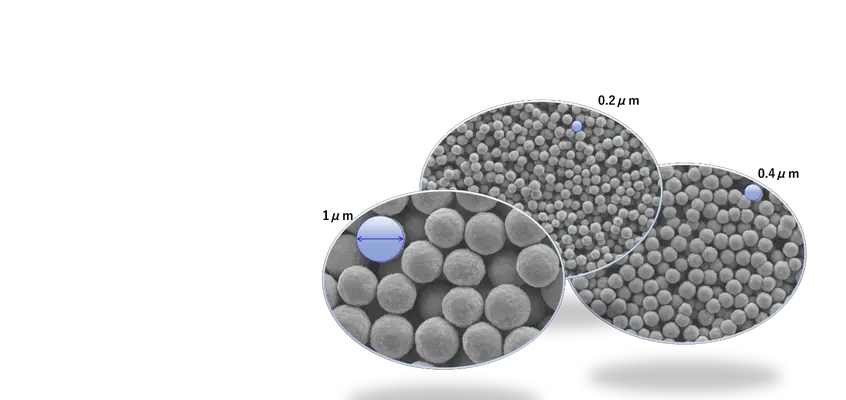
As with the nickel catalysts used in methanation, particle design is another key theme in discussions related to the development of feasible base metal catalyst technologies. The reactivity of a catalyst is not determined solely by the type of elements used because various other factors have significant effects on reaction efficiency and stability, such as catalyst particle size and distribution, specific surface area, dispersion and agglomeration properties, and surface oxidation state.
At this point, we face a major challenge. Typically, reducing the size of catalyst particles to nanoscale dimensions to increase specific surface area increases the number of active sites per unit weight, which in turn improves the conversion efficiency of raw ingredients into the target reaction product. But if a metal species is used as the fine particles, a process called sintering may occur, in which the heat generated by the chemical reaction causes agglomeration and coarsening of the fine particles, rapidly reducing catalytic activity.
In short, we must strike an ideal balance between the requirement to produce finer particles to achieve higher catalytic activity and the constraint of agglomeration that makes the catalyst difficult to handle. This is where the catalyst support becomes important. It serves as the foundation for uniformly dispersing fine catalyst particles and is crucial for addressing issues specific to catalysts with low sintering temperatures, such as nickel and copper.
Typical support materials include alumina (Al₂O₃), silica (SiO₂), and activated carbon. One method for preparing a supported catalyst is impregnation, whereby the active species (e.g., metal nanoparticles) are affixed to the surface of the support.
Thus, the practical performance of a base metal catalyst will depend on the appropriate control of the particle characteristics of the catalyst optimized for the target reaction, quality and stability during mass production, and durability. In other words, the focus of materials development extends beyond simply selecting the metal species to determining how to design the powder and make it stable enough for practical handling.
Examples of applications of base metal catalysts are not limited to methanation. For example, in the dry reforming of methane (DRM) used to produce carbon monoxide (CO) and hydrogen for use as raw materials from greenhouse gases of methane and carbon dioxide, supported catalysts are widely studied, including nickel-on-magnesium oxide catalysts, in which nickel is supported on carrier materials such as magnesium oxide (MgO).
Another emerging trend is to use ammonia (NH3) as the hydrogen carrier for efficient hydrogen transportation and storage. In reactions such as ammonia cracking to produce hydrogen, the utilization of nickel catalysts with ceria (CeO2) support and nickel alloy catalysts is attracting attention. As interest in hydrogen use grows, so does the importance of the catalyst technologies that support these conversion processes. Furthermore, although cobalt (Co) is classified as a rare metal in the narrow sense, current studies of hydrogen production and the effective use of carbon dioxide regard cobalt as a promising catalyst candidate for certain reaction systems.
A major advantage of catalysts that use base metals found in relative abundance as resources lies not just in cost-effectiveness and reliable supply, but in the well-established mining and refining technologies and supply chains. The ease of obtaining materials is also crucial for formulating plans for processes from research and development to mass production.

Base metal catalysts are fundamental technologies that provide support for realizing a carbon-neutral society and developing next-generation clean energy. They have the potential to contribute to energy conservation, the reduction of byproducts, and the efficient use of resources. Materials selection, particle design at the nanoscale level, and the design of support technologies for their implementation are all essential for achieving the desired performance.
X-MINING is intended to offer a platform that serves as the portal to such investigations. It provides insights into materials information and comparative studies that will pave the way to the next stage of co-creation. In-depth discussions based on the intersection of knowledge on materials, powders, and processes should help advance base metal catalysts from a possibility to a practical option for real-world deployment, contributing to the realization of a carbon-neutral society.
Related articles and information on relevant technologies, including materials and implementation, are also available. If you have a subject area you are currently considering, please feel free to contact us via the X-MINING “Contact Us” form. >>Contact us
Related links (materials and implementation technologies)
X-Mining combines profound expertise in materials science with industry insights to innovate and solve challenges. If you see potential for collaboration, please contact us with any questions.
Introducing Sumitomo Metal Mining’s material products,
which are the starting point for X-MINING innovation.