Fe-Ga Alloy Single Crystal 【R&D】


閉じる
閉じる
Search

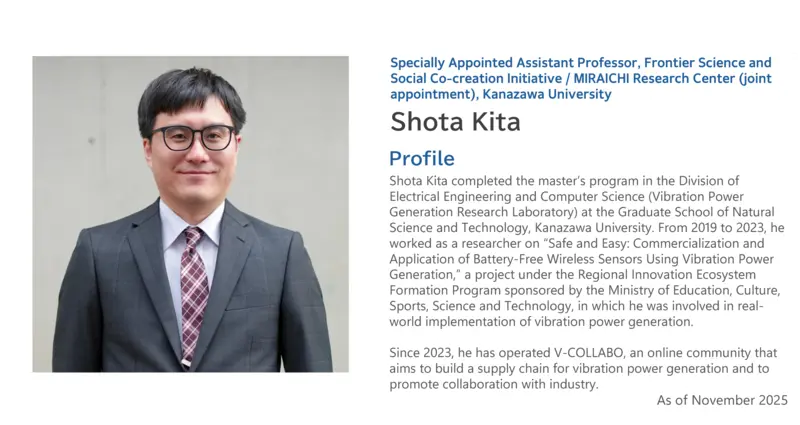
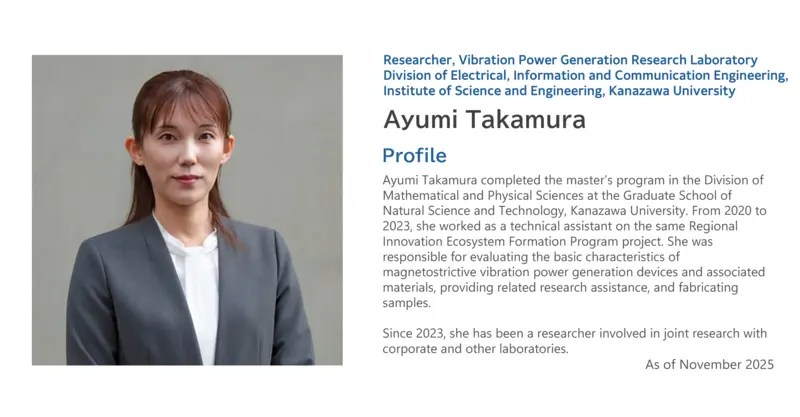
Vibration power generation devices, which convert minute vibrations into electricity, offer new ways to monitor infrastructure and plant equipment. Since 2018, Kanazawa University’s Vibration Power Generation Research Laboratory and Sumitomo Metal Mining have been engaging in joint research using Sumitomo Metal Mining’s iron-gallium magnetostrictive alloy single crystals. In this interview, Shota Kita and Ayumi Takamura from Kanazawa University discuss the potential of the devices.
――What are the characteristics of iron-gallium magnetostrictive alloy single crystals?
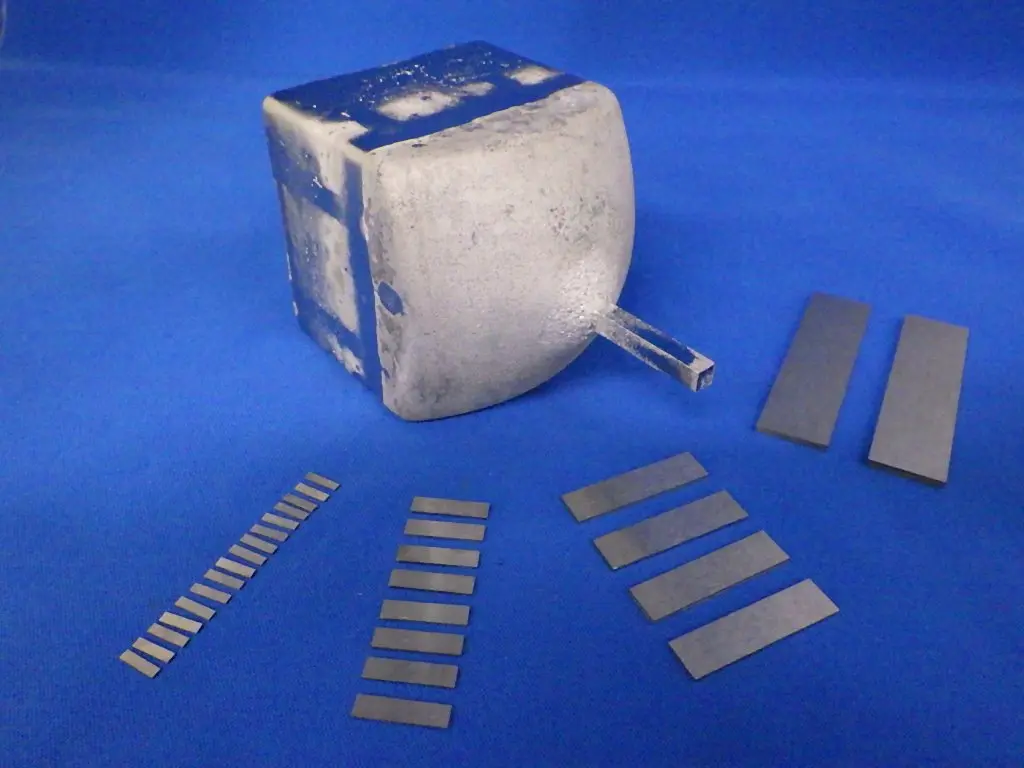
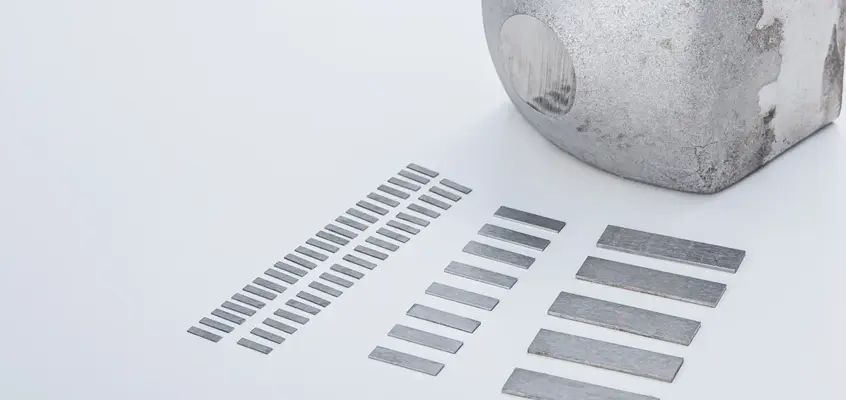
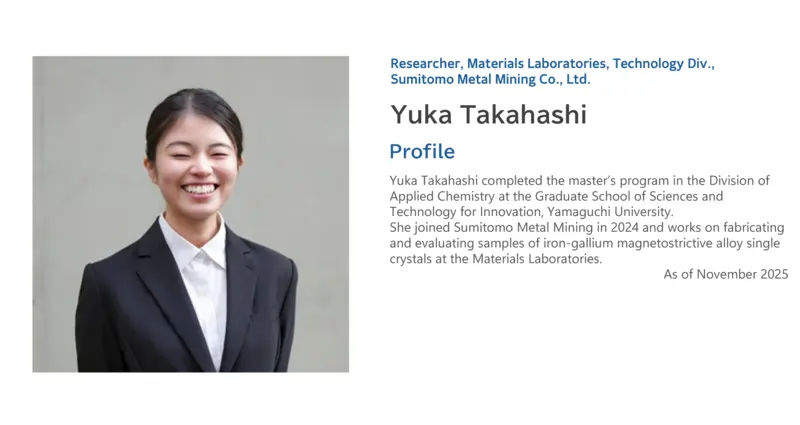
Takahashi: Magnetostrictive materials are materials that change shape and stretch along the direction of magnetization when a magnet is brought close. Our iron-gallium magnetostrictive alloy single crystals are plate-shaped, and made by adding gallium to iron to achieve a composition of roughly 80% iron and 20% gallium, with the atoms aligned in one direction to form a single crystal. This confers stable magnetic properties.
Izumi: Iron itself has magnetostrictive properties and extends in the direction in which it is magnetized. If you apply a mechanical force, it loses its magnetization and reverts to its original length. This is called the inverse magnetostrictive effect.
Due to this effect, even minute vibrations that are invisible to the naked eye can result in significant changes in magnetic flux*. It occurred to us that by using electromagnetic induction and converting these changes in magnetic flux into electricity, we could create new technologies that could be useful in the future, and we’ve been pursuing this idea ever since.
Several other materials demonstrate similar effects, including vanadium-cobalt alloys and rare-earth-based materials. But after carefully reviewing materials in terms of safety—no toxicity and low environmental impact—we arrived at iron-gallium as the material that offers both significant magnetostriction and a high level of safety.
*Magnetic flux: A measure of the strength of a magnetic field over a given area.
――When did your joint research with Kanazawa University begin?
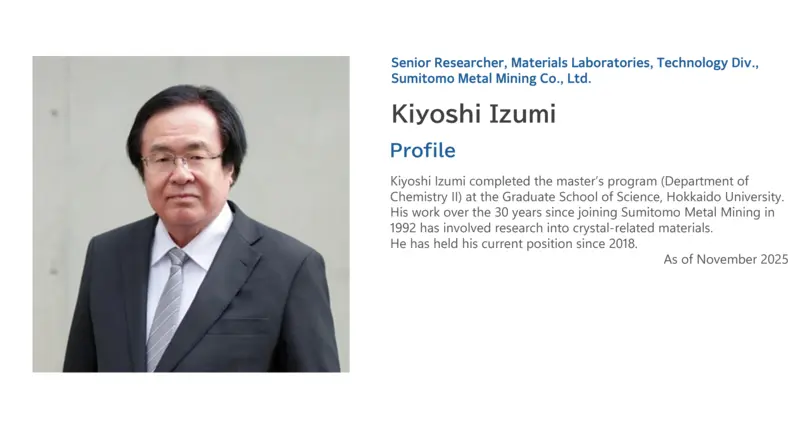
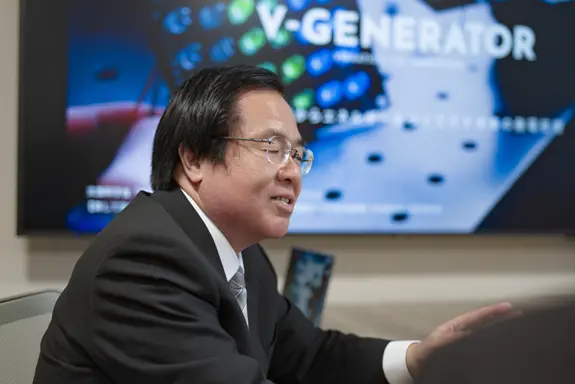
Izumi: This research goes back to around 2016, before I joined the project. At that time, Professor Toshiyuki Ueno at Kanazawa University was developing a vibration power generation device called V-GENERATOR, and my predecessor contacted him. The material hadn’t yet been made into a single crystal at that time, but after I took over, we succeeded in growing a single crystal in 2018. We asked Professor Ueno to try using the material in his V-GENERATOR research.
Kita: V-GENERATOR is a magnetostrictive vibration power generation device being developed by the Vibration Power Generation Research Laboratory at Kanazawa University, with real-world deployment in mind.
Most of us recall an elementary school experiment in which we saw that rapidly moving a magnet in and out of a coil generates electricity and lights up a small bulb. V-GENERATOR relies on the same basic principle of electromagnetic induction, but instead of moving a magnet, it generates power through expansion and contraction of magnetostrictive materials.
Iron-gallium produces a large change in magnetic flux even with only slight expansion and contraction. Using this material makes it possible to generate electricity efficiently from minute vibrations.
Kita: That said, not just any iron-gallium will do. If the properties of magnetostrictive materials aren’t stable, we can’t properly interpret our experiments. And, when we move toward mass production after real-world deployment, ensuring such stability becomes a major challenge.
Sumitomo Metal Mining’s iron-gallium magnetostrictive alloy single crystals offer highly stable properties, which have helped tremendously in advancing our research.
Takamura: I actually engage in the experiments, so I really feel how good the material is. For example, if we fabricate and compare five experimental samples, we cannot get reliable comparative data unless the material properties are consistent.
The materials from Sumitomo Metal Mining give us reliable results with a clear technical basis. Because there’s so little variation in properties between samples, our work process has become more efficient, and our research is progressing faster.
――Why are the magnetostrictive properties of iron-gallium magnetostrictive alloy single crystals so stable?
Izumi: There are two main reasons. One is the precision of the crystal growth, and the other is the high level of our processing technologies.
Iron-gallium is produced by a crystal growth process that entails dissolving gallium into cleanly stacked iron crystals with a body-centered cubic (BCC) structure. Magnetostriction occurs when the BCC structure deforms. If the gallium isn’t evenly distributed, the deformation of the lattice will vary from place to place, making the properties unstable.
We’re constantly pursuing research on how to distribute gallium as uniformly as possible, grow clean crystals, and make the material expand and contract evenly.
Processing technologies are needed to control the direction in which the material expands and contracts. Even if the quality of the crystal itself is excellent, merely cutting it into plates won’t provide the performance we want. The material has to be carefully processed and aligned. Only then will each plate vibrate in the same way.
Sumitomo Metal Mining works with many kinds of single-crystal materials other than iron-gallium. For any of them, we don’t stop at growing the crystals to apply advanced processing technologies.
We possess both sophisticated growth and processing technologies that allow us to supply materials capable of meeting the demanding requirements of university research.
――What applications do you foresee for the technologies made possible by V-GENERATOR?
Kita: We focused on two main aspects in our project from 2019 to 2023.
The first aspect was production equipment at plants. Equipment, like processing tools, is constantly vibrating. At the same time, there’s a strong need to monitor the status of such equipment. On a production line, a single piece of equipment that stops working can shut down the entire line, which can result in losses on the order of hundreds of millions of yen in a single day—equivalent to several million U.S. dollars. That underscores the importance of continuous monitoring.
Our idea is to attach sensors to such equipment and power them with vibration power generation devices so that we can detect abnormalities as quickly as possible.
You might say, “Plants already have plenty of power sources. Why use vibration power?” Because monitoring numerous points results in a proliferation of wiring, which creates trip hazards and cable breakage risks. Relying on battery power means managing and replacing many battery cells, which becomes a major burden. Using vibrational energy eliminates all these risks and disadvantages.
The second aspect was infrastructure monitoring. Aging infrastructure is a major issue for national and local governments. Across Japan, water pipes are bursting, and accidents have occurred overseas in which bridges suddenly collapse, with numerous resulting fatalities. In Japan, labor shortages mean inspections aren’t always carried out as thoroughly as they should be.
Deploying sensors at locations that are hard to inspect or in places that present hazard risks lets us identify early warning signals and take appropriate measures, like closing roads, before accidents happen.
This benefits not just local governments, but the companies responsible for performing the inspections. The sensors eliminate the need to send employees to distant or hazardous locations, which helps reduce personnel and travel costs and improve employee safety.
Recently, growing numbers of research projects require larger iron-gallium samples. Sumitomo Metal Mining has been very responsive to these needs, and that support is extremely valuable for us.
Izumi: We’re constantly trying to improve the performance of our magnetostrictive materials. The current version is clearly more precise than the first samples we supplied.
The first samples measured around the dimensions of a little finger. In 2024, we provided plates measuring roughly 96 mm × 24 mm × 3 mm. The larger the plate, the harder it is to grow a perfect crystal. We’re continuing research so that we can respond to demand for even larger sizes.
Takahashi: We have to strictly control both speed and temperature during the crystal growth process. The optimal values change slightly depending on dimensions, and even a small deviation can affect the uniformity. That’s what makes scaling up so challenging.

Izumi: As the crystals get larger, processing becomes harder. The bigger the plate, the harder it is to uniformly align the direction of magnetostriction across the entire piece. We believe that new innovations will be needed to overcome this challenge.
In Part 2, we will take a look at Kanazawa University’s efforts to build a supply chain for vibration power generation devices as these devices move toward real-world deployment. We will also discuss the future of co-creation between Kanazawa University and Sumitomo Metal Mining.
To be continued in 【Part 2】 The Unlimited Potential of Vibration Power Generation—Building a Supply Chain to Accelerate Real-World Implementation
「X-MINING is a new co-creation initiative that aims to create future-focused innovations by “crossing” your ideas with our materials to “mine” new value that impacts society.
Sumitomo Metal Mining is one of Japan’s leading resource and smelting companies. We have unique technology and materials expertise. It is no longer enough to keep these resources to ourselves. To make the most of them and achieve innovation, we must collaborate with partners. This is the vision of X-MINING.
On This Website, we introduce a wide range of functions, technologies, and solution examples of our materials. We aim to combine our products with your ideas to create new value that impacts society.
Ready to get started? Contact us to talk about your requirements.
Introducing Sumitomo Metal Mining’s material products,
which are the starting point for X-MINING innovation.