Near-Infrared Absorbing Materials

閉じる
閉じる
Search
Rare earth elements (REEs) are a set of Group 3 elements of the periodic table, excluding those in the actinide series. They comprise scandium (Sc), with atomic number 21, yttrium (Y) with atomic number 39, and the 15 elements, known as the lanthanides, with atomic numbers ranging from 57–71. The term rare earth derives from the fact that these elements are typically found in relatively scarce minerals.
The term rare metals and rare earths are sometimes used interchangeably. While rare metals typically refer to non-ferrous metals that are relatively scarce or difficult to extract, whether for engineering or economic reasons, no clear universal definition exists. The term is generally understood to include the elements lithium (Li), cobalt (Co), and nickel (Ni), which are not rare earth elements.
Rare metals is a term coined and used in Japan. Note that the term may be considered identical to rare earth elements in English-speaking countries.
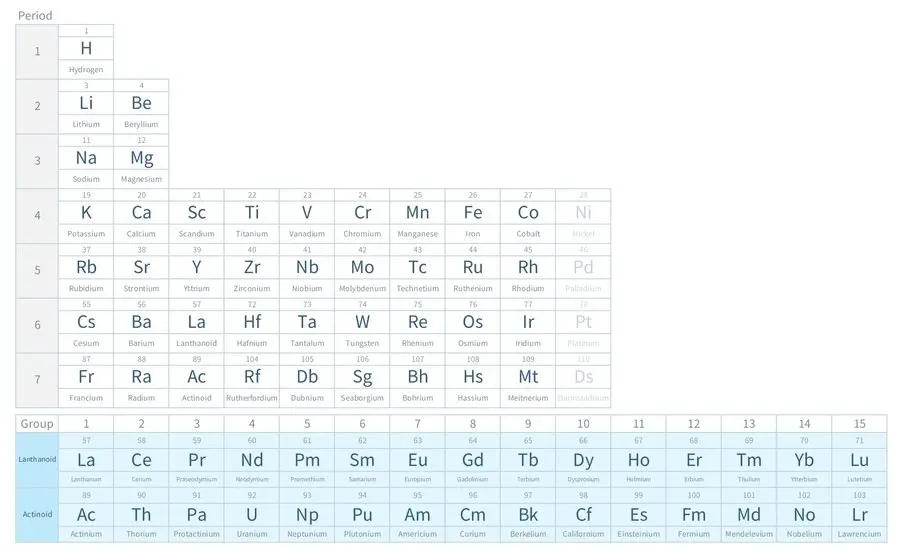
While the term rare earth elements originally referred to the 17 elements listed above, in recent years, the term has come to refer specifically to the lanthanides, which are known to coexist within the same ores, although concentrations may vary from site to site. Unlike iron or copper ores, they are not typically found in their pure form. The reserves of these elements exceed those for precious metals like gold (Au) or platinum (Pt), but they are less abundant than iron (Fe) or copper (Cu).
China currently dominates in the production of rare earth elements, but countries like Brazil, Vietnam, Russia, and India also hold reserves of comparable volumes. Recent exploration has uncovered deposits, known as rare-earth-rich mud, distributed on the deep seafloor off Japan’s shores, at depths exceeding 1,600 meters. A second key factor that allows China to maintain its overwhelming share in rare earth element production is that the manufacturing facilities for separating and extracting individual rare earth elements are primarily concentrated in China.
The major applications of each of the REEs are listed below.
• Lanthanum (La): Lanthanum is used to make optical lenses and negative electrodes for nickel-hydrogen batteries and fluorescent materials.
• Cerium (Ce): Cerium is used as a polishing agent for glass and other materials, as an exhaust gas catalyst, and as a fluorescent material. It has drawn attention in recent years as a material for solid oxide fuel cells (SOFC).
• Neodymium (Nd): Neodymium is used for sintered magnets and bonded magnets, as a doping agent in YAG laser crystals, and as a glass additive. Neodymium iron boron magnets, which exhibit strong magnetic moments, are used in wind turbines, electric vehicle (EV) engines, and air conditioner compressors. Rapid growth in demand has raised concerns over price risks. In recent years, sintered neodymium iron boron magnets using mischmetals additionally blended with lighter rare earth elements like lanthanum (La) and cerium (Ce) have also been developed.
• Promethium (Pm): No stable isotopes of promethium occur naturally. It has no industrial applications.
• Samarium (Sm): Used in magnets, as catalysts, and for other applications, samarium cobalt magnets were once widely used due to their high thermal stability. However, due to the high cost of cobalt and the brittleness and low impact resistance of the material, once neodymium magnets exhibiting even higher magnetic moments became available in the 1980s, the use of samarium cobalt magnets declined. Current applications of samarium cobalt magnets tend to be limited to those requiring high thermal stability in high-temperature environments.
Samarium iron nitrogen (SmFeN) magnets offer higher coercivity and better thermal resistance than neodymium magnets. However, they are susceptible to thermal decomposition at high temperatures, which makes it difficult to enhance performance through sintering. They are used primarily for bonded magnets, for which finely powdered magnetic materials are mixed with resin and subsequently molded. Bonded magnets offer excellent formability and dimensional accuracy, making them ideal for creating thin-walled magnets or magnets with complex shapes. They are increasingly being adopted for use in compact motors and sensors that take advantage of the design flexibility they offer.
• Europium (Eu): Europium is used as a luminescent and fluorescent material.
• Gadolinium (Gd): Gadolinium is used as a doping agent in neodymium iron boron magnets. Research in recent years has focused on potential use as a material for magnetic refrigeration.
• Terbium (Tb): Terbium is used as a doping agent in neodymium iron boron magnets and print heads.
• Dysprosium (Dy): Dysprosium is used as a doping agent in neodymium iron boron magnets and laser crystals. In particular, it is known to enhance coercivity in neodymium iron boron magnets. It is added to magnets designed for use in high-temperature environments or for applications in which strong demagnetizing fields are present. Its low content in ores, coupled, as with neodymium, with rapidly growing demand, has raised concerns over price risks. Development is currently underway to produce neodymium iron boron magnets that do not contain dysprosium.
• Holmium (Ho): Although holmium is used as a doping agent for YAG laser crystals and in other applications, its use is limited by its low content in ores.
• Erbium (Er): Erbium is used as a doping agent for YAG laser crystals and as a coloring agent for glass.
• Thulium (Tm): Thulium finds applications in surgical laser crystals and portable X-ray devices. Research in recent years has explored its use as a luminescent material.
• Ytterbium (Yb): Ytterbium is used as a doping agent for YAG laser crystals and as a glass additive, among other applications.
• Lutetium (Lu): Current research is exploring use of lutetium as a catalyst. It is regarded to have limited practical use for industrial applications due to poor productivity and cost issues.
Before the 1950s, ferrite magnets, Alnico magnets, and platinum-cobalt magnets—magnet materials made from oxides and intermetallic compounds that did not use rare earth elements—were invented and put into practical use. In the 20th century, it was discovered that among the transition metals, iron (Fe), cobalt (Co), and nickel (Ni)—which possess characteristic electron configurations in the 3d orbitals—and rare earth elements—which possess characteristic electron configurations in the 4f orbitals—exhibit exceptionally high magnetic moments. Research since then has been conducted based on the idea that combining these elements could create a stronger magnet, which led to the development of the samarium-cobalt magnet composed of samarium (Sm) and cobalt (Co) in 1969, the neodymium-iron-boron (NdFeB) magnet in 1983, and the samarium-iron-nitrogen (SmFeN) magnet in 1990. Industrial production followed development.
Samarium cobalt magnets (commonly referred to as SmCo magnets) include magnets with the compound structure of Sm1Co5 (commonly referred to as the 1:5 series SmCo magnets) and Sm2Co17 (commonly referred to as the 2:17 series SmCo magnets). Research efforts have examined PrCo5 and CeCo5 magnets, which use praseodymium (Pr) or cerium (Ce), respectively, in place of samarium. However, since SmCo5 magnets exhibit higher coercivity and higher Curie temperature (TC)—an indicator of suitability for high-temperature applications—the SmCo5 magnet was ultimately chosen for industrial production of sintered and bonded magnets. The maximum energy product achieved by the 1:5 series sintered SmCo magnets, 120–160 kJ/m³ (16–20 MGOe), surpassed the maximum energy product of 95 kJ/m³ (12 MGOe) recorded with conventional platinum-cobalt (PtCo) magnets, which established SmCo magnets as pioneering rare earth magnets offering high maximum energy product at low cost.
However, the 2:17 series SmCo magnets developed after the 1:5 series achieved a maximum energy product exceeding 200 kJ/m³ (25 MGOe) with lower samarium (Sm) content, dethroning the 1:5 series as the stronger magnet. It remains in use today in applications involving high-temperature environments exceeding 200°C, or in applications sensitive to temperature changes, corrosion, or rust. Specific applications include sensors.
In 1983, neodymium-iron-boron magnets were independently devised and marketed by different companies, using either the liquid quenching (melt spinning) or powder sintering method. The magnets produced by the former method were compression-molded bonded by mixing magnetic powder with resin and formed by press molding, for which demand grew rapidly for use in spindle motors of hard disk drives (HDD). Magnets produced by the latter method were marketed as sintered magnets, which also saw growing demand for use in HDD head actuators. Demand for sintered neodymium magnets is projected to continue growing, since these magnets serve as a key material for applications involving countering global warming, including use in air conditioner compressors, in motors for electric vehicles (EVs) including hybrid vehicles, and in wind turbines, as well as medical MRI systems.
Samarium iron nitrogen magnets are rare earth magnets composed primarily of Sm2Fe17N3, a compound formed by incorporating nitrogen (N) into Sm2Fe17, a samarium-iron compound. These magnets were first proposed in 1990 for their significant magnetocrystalline anisotropy, with properties potentially surpassing those of neodymium iron boron (NdFeB) magnets.
However, the crystal structure of Sm2Fe17N3 is known to break down at temperatures above 500°C, resulting in the loss of its magnetic properties. For this reason, SmFeN magnets have never been marketed as sintered magnets, and are currently used primarily to produce magnets bonded with resin.
As bonded magnets, in addition to their excellent thermal properties, SmFeN magnets offer magnetic properties equal to or superior to those of commonly available bonded NdFeB magnets. SmFeN magnets also offer the advantage of not requiring elements like neodymium (Nd) and cobalt (Co), which incur high supply risks.
Due to these characteristics, SmFeN magnets are drawing attention as a new option for applications requiring bonded magnets with high design flexibility (e.g., compact motors, sensors, and actuators) and applications based on efforts to reduce dependence on specific elements.
In developing rare earth magnets, including SmCo magnetic powder and associated bonded magnets and neodymium iron boron magnet materials, we pursue research, development, and industrial production that draw on proprietary methods for manufacturing rare earth alloys.
We have pursued development and mass production of samarium iron nitrogen (SmFeN) magnets (mentioned above) since the earliest stages. Our Wellmax™ samarium iron nitrogen magnetic material is backed by more than 20 years of production experience. Making effective use of samarium (Sm) makes it possible to offer a magnetic material of stable supply volume and lower susceptibility to price fluctuations than NdFeB magnetic materials.
While SmFeN is difficult to sinter into magnets, it achieves stronger magnetic properties as a bonded magnet without neodymium or cobalt. Backed by process technologies and design expertise ranging from powder manufacturing to bonded magnet production accumulated over many years, we are among the few manufacturers capable of mass-producing this SmFeN material at an industrial scale. We provide magnets with the properties and shapes needed for specific applications.
Refer to the following page for details and examples of applications of our samarium iron nitrogen magnets.
Rare Earth Magnet Materials|X-MINING|Sumitomo Metal Mining Co., Ltd.
Contact Us
Last edit date:20201010
Ready to get started? Contact us to talk about your requirements.
Introducing Sumitomo Metal Mining’s material products,
which are the starting point for X-MINING innovation.