Near-Infrared Absorbing Materials
閉じる
閉じる
Search
Lithium Niobate Single Crystal is broadly being used in the field of photonics. Their high refractive index and excellent light transmittance make them particularly attractive for next-generation optical devices, such as augmented reality (AR) glasses.
Sumitomo Metal Mining Co., Ltd. has developed Lithium Niobate (LiNbO₃) Single Crystal with extremely low visible light absorption using proprietary technology. This article introduces the fundamentals and use case for applications of Lithium Niobate Single Crystal.
Lithium Niobate (LiNbO₃, hereafter LN) is a single crystal material to be characterized by high refractive index and high transmittance.
LN is broadly used in various industries, such as surface acoustic wave (SAW) filters that utilize its piezoelectric properties, optical modulators based on the electro-optic effect, and second harmonic generation (SHG) devices based on the nonlinear optical properties.
Recently, due to its high refractive index and transparency, LN has also attracted attention as a waveguide material for AR glasses.
Although LN is a functional material with high refractive index and transmittance, conventional LN Single Crystal has faced a challenge: There is an absorption peak in the visible light, particularly near a wavelength of 470nm.
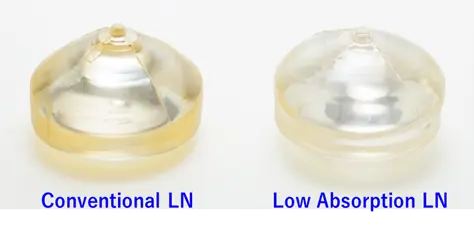
Due to this absorption peak, conventional LN crystals is yellowish. This yellowish causes to reduce transmittance and lower image quality when used in optical devices.
It has been difficult to overcome this issue without adding impurities
Sumitomo Metal Mining has developed LN Single Crystal with significantly reduced absorption near 470nm by optimizing the crystal growth conditions without adding impurities.
A comparison of the absorption coefficient β at 470nm between conventional and low-absorption LN is shown in Table 1, and actual crystal photos are presented in Figure 1.
The reduced absorption near 470nm contributes to erase yellowish.
Table 1. Comparison of Absorption Coefficient at 470 nm
| Conventional LN | Low Absorption LN | |
| Absorption Coefficient β (Wavelength 470nm) |
0.014 | 0.0066 (Approximately 50% reduction) |
Figure 1. Comparison Photos of Conventional LN and Newly Developed Low-Absorption LN Single Crystal
AR (Augmented Reality) glasses are wearable devices that overlay digital information onto the real world, enabling users to experience mixed reality of virtual reality and augmented reality.
While consumer AR glass market is still limited, AR glasses are expected to become mainstream between 2027 and 2030, potentially replacing smartphones as the next-generation device.
There are several technologies for displaying digital information on AR glasses, but the waveguide combiners have the advantage of lightweight and high image quality.
The quality requirements for waveguide materials for AR glasses are as follows:
Currently, waveguides for AR glasses are mainly used high refractive index glass. Compared to high refractive index glass, LN Single Crystal originally has characteristics both a higher refractive index and lower density. In addition, the low light absorption LN Single Crystal developed by Sumitomo Metal Mining has a feature of superior visible light transmittance.
These properties of Sumitomo Metal Mining’s LN Single Crystal bring higher performance as waveguide materials for AR glasses than conventional high refractive index glass.
Table 2: Physical Properties of Sumitomo Metal Mining's Low-Absorption LN Single Crystal for AR Glasses
| Product Name | Refractive Index | Absorption Coefficient β 470 nm |
Density | ||
| 436 nm | 546 nm | 656 nm | |||
| SMM Low-Absorption LN | 2.36 | 2.32 | 2.30 | 0.0066 | 4.62 |
| (Reference) High Refractive Index Glass | 1.90–2.05 approx. | 1.90–2.05 approx. | 1.90–2.05 approx. | 0.013–0.030 approx. | 3.5–5.1 approx. |
Table 2 compares the characteristics that affect performance of AR glass between high refractive index glass and Sumitomo Metal Mining’s LN Single Crystal.
Both the refractive index and absorption coefficient of LN Single Crystal are higher values compared to high refractive index glass.
LN Single Crystal is expected to be used to not only AR glasses but also various optical devices.
For example, optical modulators are key devices that are used for controlling and manipulating light properties, primarily to modulate various aspects of light waves.
Waveguides are structures that light from one point to another, used for optical fibers and photonic integrated circuits (PICs).
Traditionally, bulk LN Single Crystal has been broadly used for optical modulators. However, advanced technology has enabled the formation of TFLN (Thin Film Lithium Niobate) on silicon substrates.
This innovation allows volume production at wafer level and is achieving smaller and higher-performance optical modulators.
Moreover, optical modulators utilizing TFLN technology are expected to contribute to Co-Packaged Optics devices, next-generation communications, and quantum technologies.
Utilizing our technology to reduce visible light absorption of LN Single Crystal, Sumitomo Metal Mining is also developing new products to minimize optical losses in infrared light for Co-Packaged Optics devices.
We invite you to contact us for inquiries about various use cases of low light absorption LN Single Crystal, not only for AR glasses but also for other advanced optical devices.
LN Single Crystal is the focus of attention as waveguide materials for AR glasses due to their high refractive index and low absorption coefficient.
In particular, the LN Single Crystal developed by Sumitomo Metal Mining is suitable for AR glass thanks to own low visible light absorption technology.
Sumitomo Metal Mining is also developing technologies to reduce optical losses in the infrared light. Our technologies have a potential to use for optical modulators, waveguides, and Co-Packaged Optics devices.
If you are interested in our technologies, please feel free to contact Sumitomo Metal Mining.
Ready to get started? Contact us to talk about your requirements.
Introducing Sumitomo Metal Mining’s material products,
which are the starting point for X-MINING innovation.