Near-Infrared-Absorbing Materials

閉じる
閉じる
Search
Near-infrared-absorbing materials combine high visible-light transparency with strong, selective absorption of near-infrared light. Applied to windows, these materials block near-infrared energy while transmitting bright light. As a result, they significantly reduce the rise in indoor temperature.
LaB6 (lanthanum hexaboride) and CWO™ (cesium-doped tungsten oxide)*, near-infrared absorbing materials developed by Sumitomo Metal Mining Co., Ltd., selectively absorb a greater proportion of near-infrared rays in sunlight than conventional materials such as ITO (indium-doped tin oxide) and ATO (antimony-doped tin oxide).
*CWO™ is a registered trademark of Sumitomo Metal Mining. CWO™ is a near-infrared absorbing nanoparticle invented by Sumitomo Metal Mining and protected by patents and trademarks both domestically and internationally. It is a conductive nanoparticle obtained by adding cesium to tungsten oxide, representing a novel type of heat-absorbing nanoparticle independently developed in 2004. The material technology brand that employs CWO™ is SOLAMENT™.
Sunlight consists of ultraviolet rays, visible rays, near-infrared rays, and mid-infrared rays. Ultraviolet rays include UVC (wavelengths under 290 nm), UVB (290 to 320 nm), and UVA (320 to 380 nm). Visible rays have wavelengths of 380 to 780 nm. Near-infrared rays have wavelengths of 780 to 2500 nm, and mid-infrared rays have wavelengths of 2500 to 4000 nm.
Ultraviolet rays make up approximately 7% of sunlight's energy. Visible rays make up 47%, and near- and mid-infrared rays make up 46%.
Near-infrared (NIR) rays have high radiation intensity at shorter wavelengths. They can penetrate the skin and produce a strong heating effect, which is why people sometimes refer to them as "heat rays".
Manufacturers generally use heat-absorbing glass or heat-reflecting glass to shield window glass from solar radiation. Heat-absorbing glass incorporates metals such as iron (Fe), nickel, cobalt, and chromium. When mixed into the glass, these metals absorb near-infrared light. However, since the metal dopants affect the glass's color tone, it cannot maintain sufficient visible-light transparency.
In contrast, heat-reflecting glass reflects solar energy. In this case, metals and metal oxides are formed on the glass surface. However, the reflected wavelengths extend into the visible range, causing glare and radio-wave interference.
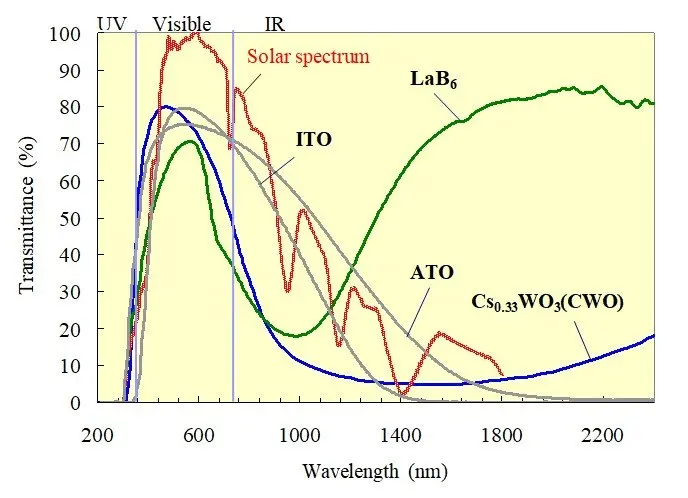
Dispersing transparent conductors, such as ITO (indium-doped tin oxide) and ATO (antimony-doped tin oxide), as nanoparticles achieves both high visible-light transparency and radio-wave transparency. This dispersion prevents radio-wave disruption and produces a transmittance profile like the one shown in Figure 1. It also creates near-infrared-selective absorption films.
However, the spectrum of sunlight contains significant energy in the 800 to 1200 nm range. Fine-particle dispersion films of ITO and ATO cannot sufficiently absorb energy in this range. Because LaB6 and CWO™ brand nanoparticles absorb light in this wavelength range, they remove near-infrared rays more efficiently than ITO and ATO.
The solar-radiation heat-acquisition rate represents the fraction of net sunlight energy that flows through the glass. The solar-radiation shielding coefficient is normalized to 3-mm-thick clear glass. Either value expresses the shading effect of sunlight quantitatively. In practice, the goal is to maximize visible-light transmission and minimize the solar-radiation shielding coefficient. Figure 2 shows this relationship for various materials.
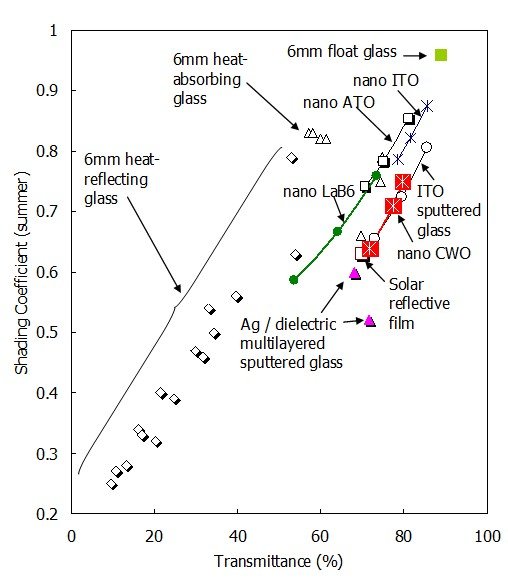
The lower-right region in Figure 2 indicates higher performance. This chart shows that ATO, LaB6, and ITO fine-particle dispersion films have better properties than heat-absorbing glass and heat-reflective glass. The CWO™ brand fine-particle dispersion film performs even better. It achieves nearly the same characteristics as ITO single-layer sputtered glass and the multilayer heat-reflective film from M Company. Notably, even though the primary function of these coating films is near-infrared absorption, they achieve solar-radiation-shielding properties equivalent to dry-process coating films with strong reflection components. They achieve these properties through a simpler, lower-cost process.
In addition, LaB6 and CWO™ require very small amounts of material because of their large absorption coefficient per unit weight. Figure 3 compares the amount of fine particles (per unit projected area) required to obtain the same solar radiation shielding factor. For LaB6 and CWO™, far less material is needed compared to ITO or ATO for equivalent solar shielding. For LaB6, the amount required to form a film with a visible light transmission of about 70% is only 0.02 g/m², approximately 1/100 that of ITO. This extremely low dispersion density offers a significant cost advantage.
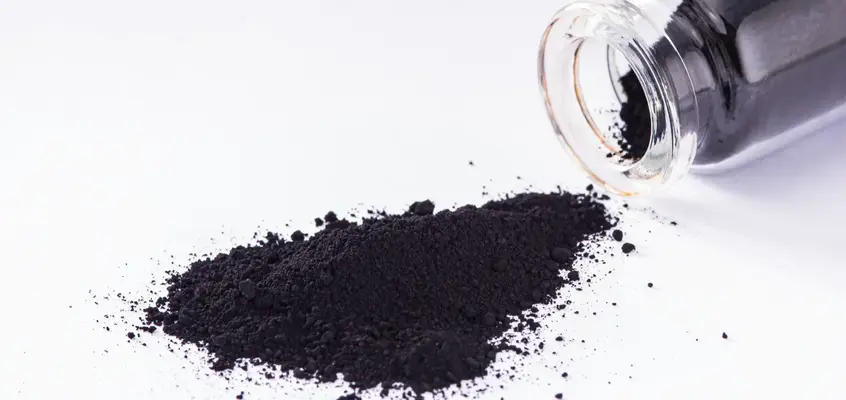
LaB6 is a black material used as an electron source for transmission electron microscopes (TEMs). All rare-earth hexaborides absorb near-infrared light, and in 1997 we discovered and patented that LaB6 has the most effective heat-shielding ability among them [6–9]. Unlike ATO and ITO, LaB6 has a slightly green color tone, but it is characterized by high transparency and a very low solar-radiation heat-acquisition rate (Fig. 3).
This is derived from the very high absorption rate of LaB6. The strong NIR absorption of LaB6 originates from localized surface plasmon resonance exhibited by conductive nanoparticles, and the absorption wavelength depends on particle shape.5)
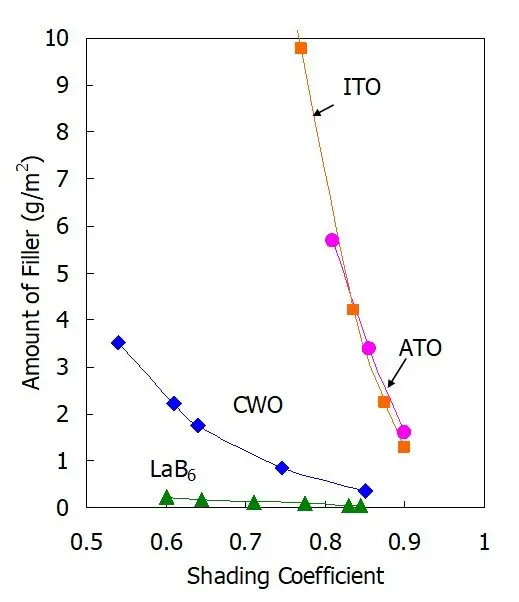
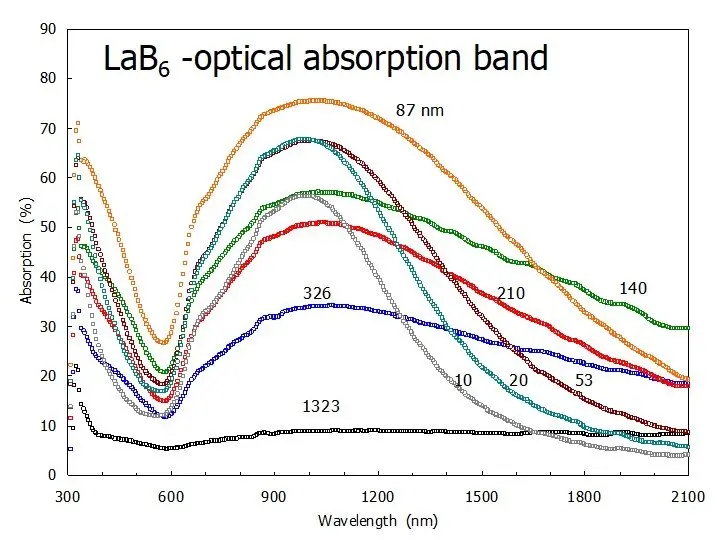
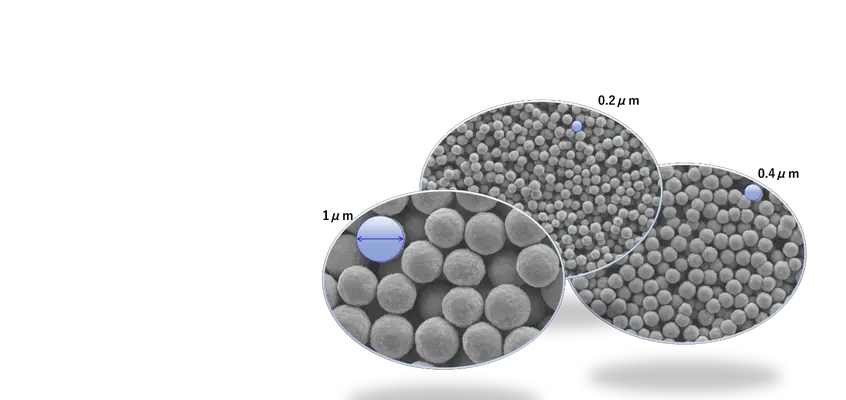
Figure 4 shows the measured absorption profiles of LaB6 dispersions with different average particle sizes. When the average particle size is 1.3 μm, near-infrared (NIR) absorption around 1000 nm does not occur. However, when the average particle size is 326 nm, some absorption occurs. As the particle size is reduced, the absorption increases within a narrower wavelength range. In other words, this absorption occurs only when the particle size reaches the nanoscale. The strongest absorption occurs when the particle size is approximately 90 nm, due to LaB6's surface faceting. Since LaB6 is an inorganic compound, LaB6 nanoparticles exhibit superior resistance to heat, light, and weather compared to common organic pigments. However, these nanoparticles may fade slightly after prolonged exposure to extreme temperatures and high humidity. To address this issue, researchers developed LaB6 particles with a silica-film coating, which improves resistance to moisture and heat.3)
CWO™ is a fine conductive particle obtained by adding cesium to tungsten trioxide (WO3) and is a heat-ray absorbing material developed by SMM in 2004.2,13-14)
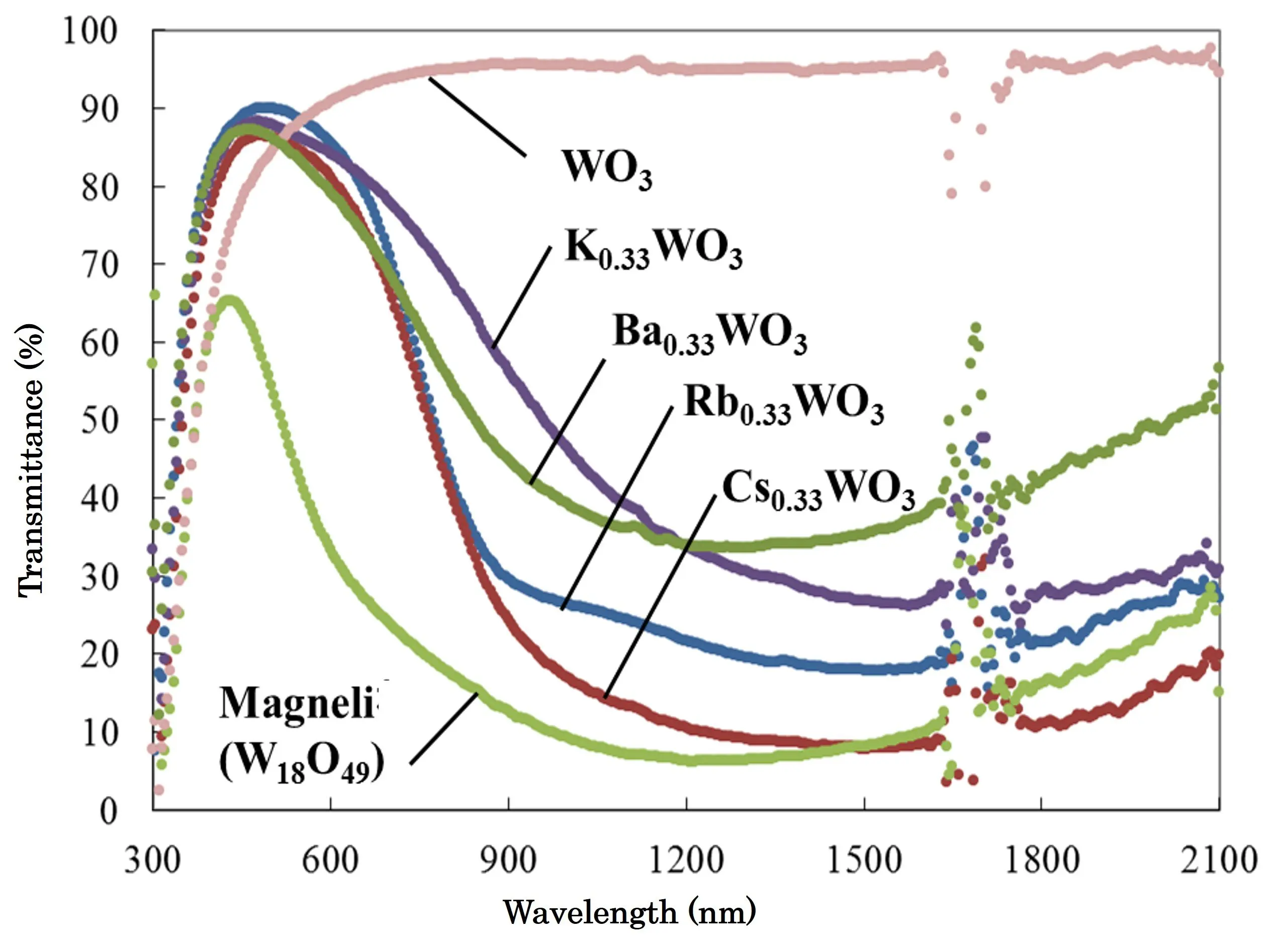
WO3 is an insulator with a monoclinic structure, but it is known to become a conductor through oxygen reduction or doping.10-11) WO3-x, formed by oxygen deficiency due to reduction, gains free electrons from the oxygen vacancies, becoming conductive. As oxygen deficiency increases, WO3-x forms a compound series called the Magnéli phases, in which the edges of WO6 octahedra are shared at various positions, and some of these phases exhibit high electron conductivity and remarkable NIR-absorbing properties.
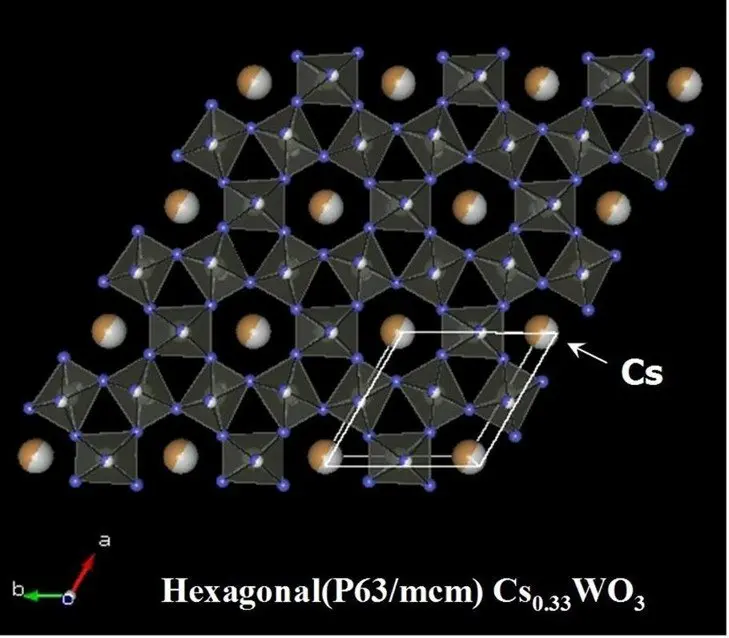
Another way to make WO3 conductive is by adding a third element. Monoclinic WO3 has regular gaps corresponding to the M-site of the perovskite-structured MWO3, and a third element such as Na can be placed in the center of these gaps at various ratios. As the ionic radii of the additive elements increase, the crystal structure changes to cubic (Na, etc.), tetragonal (Ba, etc.), and hexagonal (K, Tl, Rb, Cs, etc.). Generally, the monovalent third element M added to WO3 dissociates as M → M⁺ + e⁻ in the crystal, where M⁺ enters the voids created by WO6 octahedra while e⁻ localizes around W⁶⁺ to form W⁵⁺. This electron hopping conduction improves the conductivity of WO3, and the polaron absorption of electrons produces NIR-absorbing properties. Alkali elements with large ionic radii, such as K, Tl, Rb, and Cs, form a hexagonal tungsten bronze structure (hereinafter abbreviated as HTB) when added. The crystal structure of HTB is shown in Figure 5. In this structure, WO6 octahedra share edges, creating numerous tunnel-like voids that appear as hexagons or triangles in the basal plane cross-section. When all regular hexagonal tunnels are filled with a third element such as Cs, the atomic ratio of M to W is 0.33. When the crystal structure is HTB, visible-light transmittance increases as shown in Fig. 6, exhibiting excellent heat-absorbing properties.2,12)
SMM examined the production process of HTB fine particles with added cations and successfully established an industrially advantageous production method through optimization of raw material selection, manufacturing methods, and composition ratios. The Cs-added system was found to be the most industrially compatible combination among the HTBs studied, in terms of characteristics, weather resistance, and cost. This combination is positioned as a heat-ray absorbing material of a fine particle dispersion type that exceeds the performance of any ITO compositions so far.
1. H. Takeda, H. Kuno and K. Adachi: J. Am. Ceram. Soc., 91, 2897 (2008)
2. H. Takeda and K. Adachi: J. Am. Ceram. Soc., 90, 4059 (2007)
3. Atsushi Tofuku and Kenji Adachi: Powder Technology, Vol.2, No.11, p.37 (2011)
4. T. Chonan, A. Tofuku, K. Fujita and K. Adachi: Proc. the Third Int. Conf. on Processing Materials for Properties (PMP III), TMS, 903-908 (2008)
5. K. Adachi, M. Miratsu and T. Asahi: "Absorption and scattering of near-infra-red light by dispersed lanthanum hexaboride nanoparticles for solar control filters," J. Mater. Res., 25, pp. 510-521(2010).
6. H. Kuno, H. Takeda, and K. Adachi, "Coating solution for forming a selectively transmitting film, a selectively transmitting film and a selectively transmitting multilayer film", US Patent No. 6060154, 2002.
7. H. Kuno, H. Takeda, and K. Adachi, "Film for cutting off heat rays and a coating liquid for forming the same", US Patent No. 6277187, 6221945, 2001.
8. K. Adachi, H. Takeda, and H. Kuno, in Proceedings of the 39th Meeting of the 69th Committee of Japan Society for the Promotion of Science, 2002 (Nagoya, 2002) p. 201.
9. H. Takeda, H. Kuno, and K. Adachi, J. Am. Ceram. Soc. 91, 2897 (2008).
10. K. Bange, Solar Energy Mater. & Solar Cells 58, 1 (1999).
11. C. G. Granqvist, Solar Energy Mater. & Solar Cells 60, 201 (2000)
12. K. Adachi and T. Asahi: J. Mater. Res., 27, 965 (2012).
13. H. Takeda, and K. Adachi, "Infrared shielding material microparticle dispersion infrared shield, process for producing infrared shield material microparticle and infrared shielding material microparticle", US Patent No. 0178254, 2006.
14. H. Takeda and K. Adachi, "Fine particle dispersion of infrared-shielding material, infrared-shielding body, and production method of fine particles of infrared-shielding material and fine particles of infrared-shielding material", US Patent No. 8083847, 2011.
X-Mining combines profound expertise in materials science with industry insights to innovate and solve challenges. If you see potential for collaboration, please contact us with any questions.
Introducing Sumitomo Metal Mining’s material products,
which are the starting point for X-MINING innovation.